
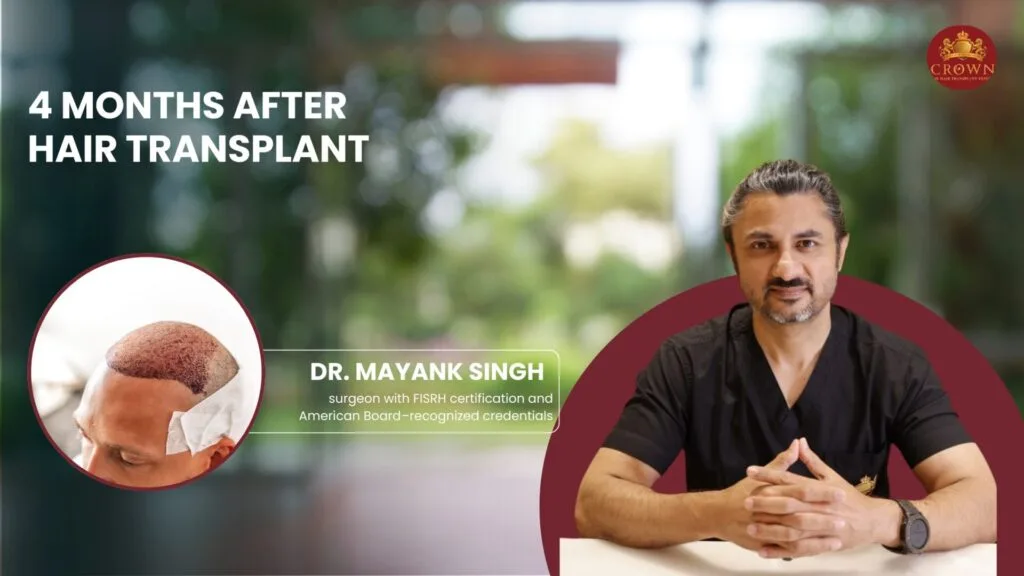
Four months after a hair transplant marks the point at which transplanted follicles begin producing visible new growth. The initial weeks post-procedure involve shedding of transplanted hairs, which is a normal part of the follicle cycle. By month four, those follicles have completed the resting phase and entered the active growth stage. What patients see at this point is early-stage growth thin, fine strands emerging from the recipient zone not the final result. Full density develops progressively over the following months.
According to Dr. Mayank Singh,
FUE Hair Transplant growth at four months is the beginning of the visible result phase, not the end. “Patients who assess their outcome at four months are looking at approximately 20 to 30 percent of their final result. The rest develops through months six to twelve.”
What Happens at 4 Months After Hair Transplant?
The four-month mark is a specific and well-documented stage in the post-transplant growth timeline. Understanding what is normal at this point prevents unnecessary concern and premature conclusions about the procedure outcome.
Initial growth emerges as fine, thin strands — New hair at four months is typically finer in calibre than mature hair. This is normal. The follicle has reactivated and begun producing hair, but the shaft has not yet reached its full thickness. Texture and calibre improve progressively over the following months. At Crown Hair Transplant, patients are briefed on this timeline before the procedure so expectations are accurate from the outset.
Not all grafts emerge simultaneously — Follicles do not reactivate at the same rate. Some grafts will produce visible growth at four months. Others may not emerge until month five or six. Uneven early growth is standard and does not indicate graft failure. The full distribution of growth becomes visible closer to the six-month mark.
The recipient area may still look sparse — Because only a portion of grafts have produced visible growth at four months, the overall density in the recipient zone will not yet reflect the planned final result. Patients who compare their four-month appearance to their anticipated final outcome will consistently find it falls short — because it is supposed to at this stage.
Shedding of early growth can occur — Some patients experience a secondary shedding of the initial fine growth around month three to four. This is part of the follicle cycling process and does not indicate a problem. The follicle remains intact and resumes growth after this phase.
For a detailed look at what makes FUE a reliable method for long-term results, read our previous blog — Is FUE a Reliable Method for Hair Restoration?
Should You Be Concerned at 4 Months Post Transplant?
Most concerns patients raise at four months are related to the growth timeline being slower or less dense than expected. In the majority of cases, these are not clinical problems.
Sparse growth at four months is expected — The procedure produces its full result at twelve months. Four months represents approximately 20 to 30 percent of that result in most patients. Comparing a four-month outcome to the final target is not a clinically valid assessment of whether the procedure has worked.
Crown area growth is slower than frontal growth — Patients who had crown restoration as part of their Hair Grafting procedure will notice that growth in the crown lags behind frontal growth by several weeks to months. Lower blood supply to the crown slows the follicle reactivation timeline in that zone.
PRP therapy at this stage can support growth — Hair PRP Treatment used post-transplant stimulates follicle activity and improves scalp circulation during the active growth phase. Where growth appears slower than expected at four months, PRP is one of the supportive options worth discussing at a follow-up consultation.
Genuine graft failure has specific clinical signs — If large defined areas of the recipient zone show no growth whatsoever by month four to five, a clinical review is appropriate. Isolated slow growth across the recipient zone is normal. Complete absence of any growth in a specific zone is worth assessing with the treating surgeon.
Why Choose Dr. Mayank Singh for Hair Transplant Follow-Up?
Dr. Mayank Singh is the President of the Association of Hair Restoration Surgeons of India, a Diplomate of the American Board of Hair Restoration Surgery, and a Fellow of the International Society of Hair Restoration Surgeons. He is the only surgeon in India to have received the Shelly Friedman Award. Post-transplant follow-up at Crown includes growth monitoring at key milestones one month, three months, six months, and twelve months. The four-month stage is specifically where patients benefit from a direct clinical review to confirm growth is progressing normally and to address any concerns before they develop into unnecessary anxiety about a procedure that is still mid-course.
FAQs
Is it normal to have uneven hair growth 4 months after hair transplant?
Yes, uneven growth is completely normal and evens out over the next few months.
How much hair growth should I expect at 4 months after hair transplant?
You can expect approximately 30–40% of total growth by this stage
Can I cut or style my hair 4 months after hair transplant?
Yes, gentle haircuts and styling are usually safe at this point.
When will full results of a hair transplant be visible?
Final results are typically seen between 9–12 months after the procedure.