
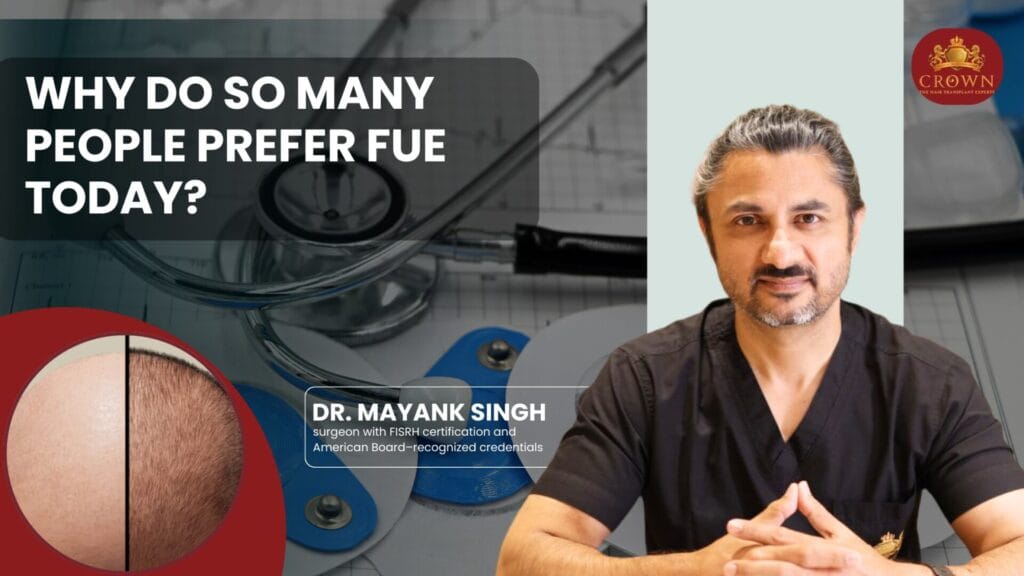
FUE is preferred because it delivers permanent hair restoration without a linear scar, requires no stitches, and allows return to daily routine within seven to ten days. Individual follicle extraction preserves the donor area for future sessions and gives the surgeon precise control over graft placement and hairline design. These are clinical advantages, not cosmetic preferences.
According to Dr. Mayank Singh, FUE Hair Transplant maintains donor area safety while allowing balanced density planning. “Careful planning and correct graft placement are more important than the technique name. Suitability must be assessed individually before FUE is recommended.”
What Makes FUE Different From Other Hair Restoration Methods?
The distinction between FUE and strip-based techniques produces measurable differences across several patient-relevant categories that directly explain the preference shift.
- No linear scar — FUE extracts follicles through small circular punch incisions that heal as tiny, distributed dots across the donor zone. No strip is removed and no sutured wound is created. Patients who maintain short hairstyles are not limited by a visible linear donor scar. At Crown Hair Transplant, donor zone mapping is completed before extraction begins to maintain consistent density distribution.
- Minimally invasive with faster recovery — Small extraction points heal independently without stitches. Most patients return to daily routine within seven to ten days. The absence of a sutured donor wound reduces both recovery time and post-surgical discomfort compared to strip procedures.
- Natural hairline design through precise placement — Each graft is placed at the exact angle and direction of the patient’s original hair growth. Single-hair follicular units are used at the outermost hairline edge to create a soft, natural transition. Multi-hair units behind that zone build density progressively.
- Donor area preserved for future sessions — Individual extraction distributed across the donor zone keeps surrounding follicle density intact. Future sessions remain possible if hair loss continues progressing after the initial procedure without the donor zone being significantly depleted.
For a full clinical assessment of what makes FUE reliable long-term, read our previous blog — Why Is FUE Getting So Much Attention Today?
Is FUE Suitable for Crown Hair Transplant Areas?
FUE is used for crown restoration but planning requirements in the crown differ significantly from frontal hairline work and cannot be treated as secondary considerations.
- Precise graft placement for the circular swirl pattern — Crown hair grows in a natural circular direction. Every graft must follow that swirl exactly. Deviation from it produces a flat, unnatural result regardless of how many grafts were placed. At Crown Hair Transplant, swirl mapping is completed before any recipient sites are created in the crown zone.
- Gradual density planning prevents donor depletion — The crown frequently requires a high graft count for adequate coverage. Allocation is planned to achieve the required density without exhausting the donor supply needed for future sessions if hair loss continues to progress.
- Long-term thinning projection is non-negotiable — FUE Hair Transplant planning for the crown must account for ongoing hair loss behind the transplanted zone. A plan that addresses only current loss produces a result that requires revision within a few years.
- Growth in the crown develops more slowly — Blood supply to the crown is lower than at the frontal scalp. Visible density after crown grafting takes additional months to develop beyond the standard frontal timeline. Patients are informed of this before the procedure begins.
Why Choose Dr. Mayank Singh for FUE Hair Transplant?
Dr. Mayank Singh is the President of the Association of Hair Restoration Surgeons of India, a Diplomate of the American Board of Hair Restoration Surgery, and a Fellow of the International Society of Hair Restoration Surgeons. He is the only surgeon in India to have received the Shelly Friedman Award. For FUE Hair Transplant specifically, every case begins with detailed scalp analysis, donor evaluation, and graft angulation planning before any extraction is confirmed. FUE is recommended based on clinical suitability donor density, extent of hair loss, hairstyle requirements, and long-term thinning trajectory not on the basis of it being the most requested procedure in the current market.
📞 Call Now:.+91-9015112233
Book your Treatment consultation at Crown Hair Transplant today. Same-day appointments available for urgent cases.
FAQs
FUE is preferred for minimal scarring, but suitability depends on individual scalp condition.
Initial healing usually takes about 7–10 days.
New growth generally begins after 3–4 months.
Yes, transplanted hair from stable donor areas is usually permanent.