
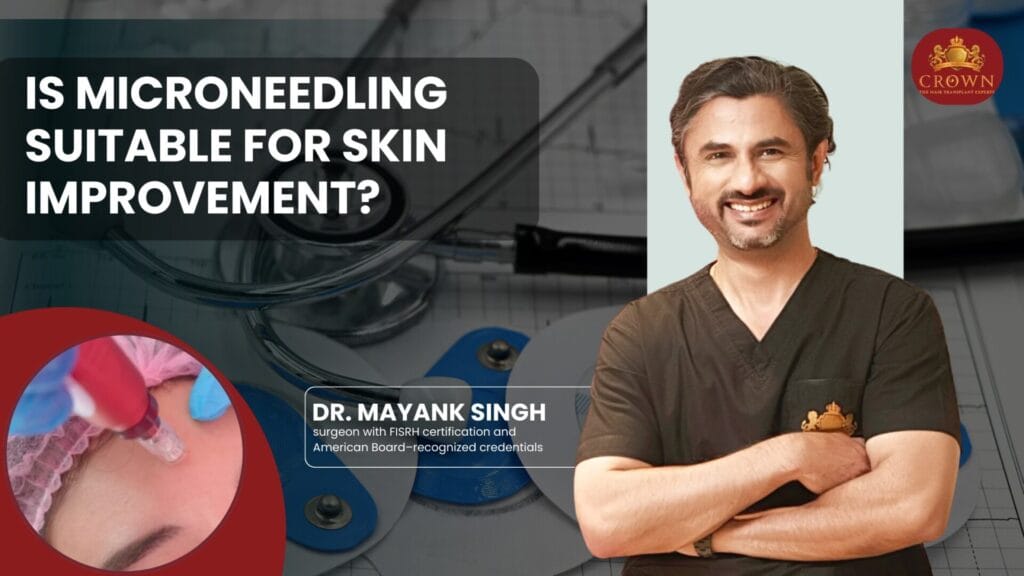
Microneedling is clinically suitable for skin improvement when a specific structural skin concern is present that the collagen-stimulating mechanism can address. It works by creating controlled micro-injuries at the dermal layer, triggering the body’s repair response to produce new collagen and elastin. Acne scars, uneven texture, enlarged pores, fine lines, and early skin laxity all respond to this mechanism when the skin is in a condition that allows safe treatment and the correct needle depth is applied.
According to Dr. Mayank Singh,
Microneedling is suitable for individuals with mild acne scars, fine lines, and uneven texture when proper skin evaluation and technique selection are applied. “Safe healing and gradual skin enhancement depend on correct assessment before treatment begins, not on the treatment alone.”
How Does Microneedling Improve Skin?
Each clinical outcome from microneedling is a direct product of what the controlled micro-injury response produces at the structural level of the skin.
- Boosts collagen and elastin production — Micro-punctures trigger fibroblast activation at the dermal layer. Fibroblasts produce new collagen and elastin to repair the injury sites. This structural rebuilding is what improves skin firmness, texture, and elasticity progressively across a treatment course. At Crown Hair Transplant, needle depth is calibrated to reach the correct dermal layer before any session begins.
- Reduces acne scars through collagen remodelling — Depressed acne scars form when collagen is destroyed during the inflammatory phase of a breakout. Microneedling stimulates new collagen production in and around the scar tissue, gradually raising the depressed area toward the surrounding skin level over successive sessions.
- Improves skin tone and surface clarity — Regular sessions improve blood circulation to the treated zone and support more even cell turnover. Combined with topical serums applied post-session through the open micro-channels, improvement in pigmentation irregularity compounds alongside texture correction.
- Minimally invasive with short recovery — Mild redness lasting one to three days is the standard post-session response. No incisions, no stitches, and no extended downtime. Combined with Hair PRP Treatment applied post-session, both the skin repair and follicle stimulation responses are measurably stronger.
For a detailed breakdown of how microneedling works on skin elasticity specifically, read our previous blog — Can Microneedling Improve Skin Elasticity?
Is Microneedling Suitable for Scalp and Crown Hair Transplant Areas?
Microneedling is used for scalp improvement under specific conditions and with specific timing requirements that differ from facial skin treatment.
- Supports scalp circulation in thinning areas — Controlled micro-injury on the scalp improves blood flow to follicle roots. Better circulation delivers more oxygen and nutrients to each follicle. When used on early-stage thinning zones, scalp microneedling supports follicle activity in conjunction with Hair Grafting recovery protocols.
- Improves absorption of topical scalp treatments — Micro-channels created during scalp microneedling allow prescribed topical solutions to penetrate significantly deeper into scalp tissue than they would on an untreated surface. The combined effect on follicle activity is stronger when topical therapy is applied immediately post-session.
- Timing after crown hair transplant must be clinically confirmed — Scalp microneedling near or around a crown hair transplant zone must be scheduled at the appropriate healing stage. Microneedling too early after graft placement risks disturbing newly implanted follicles. Timing is confirmed at post-surgical review, not self-determined.
- Active scalp conditions must be resolved first — Active infection, severe inflammation, or certain dermatological conditions on the scalp require resolution before microneedling can be safely administered. Treating a compromised scalp produces inconsistent results and increases adverse reaction risk.
Why Choose Dr. Mayank Singh for Microneedling Treatment?
Dr. Mayank Singh is the President of the Association of Hair Restoration Surgeons of India, a Diplomate of the American Board of Hair Restoration Surgery, and a Fellow of the International Society of Hair Restoration Surgeons. He is the only surgeon in India to have received the Shelly Friedman Award. For Microneedling specifically, skin type, concern severity, and treatment history are all evaluated before any session is planned. Needle depth, session spacing, and post-procedure protocol are determined by what the individual patient’s skin or scalp requires. Treatment begins only when the skin is confirmed to be in a condition that supports safe and effective collagen stimulation.
📞 Call Now:.+91-9015112233
Book your Treatment consultation at Crown Hair Transplant today. Same-day appointments available for urgent cases.
FAQs
A numbing cream is usually applied to minimize discomfort during the procedure.
Multiple sessions are often recommended depending on skin concern.
Initial improvement may be noticed within a few weeks, with gradual enhancement over time.
Mild redness may last for 1–3 days.