
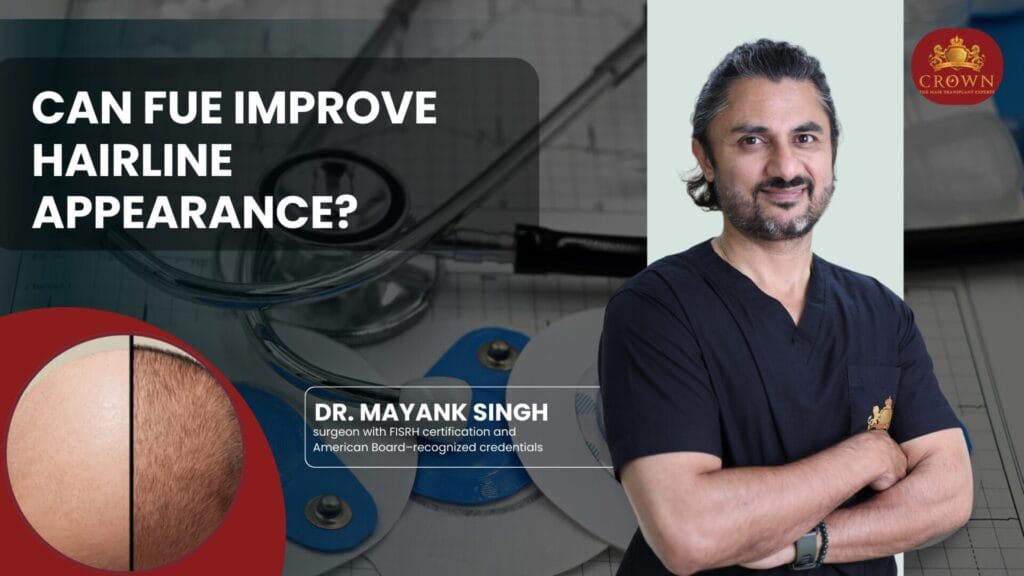
FUE hair transplant improves hairline appearance by relocating individual follicular units from the donor area to the receding or absent hairline zone. The procedure can restore a hairline that has receded, define one that has become unclear, or strengthen one that is thinning at the edges. The outcome depends not on the number of grafts placed but on how the hairline is designed before any extraction begins. Angle, direction, follicle selection, and position relative to facial structure all determine whether the result looks natural or placed.
According to Dr. Mayank Singh,
FUE Hair Transplant hairline improvement begins with reading the face first and designing around it. “The angle, depth, and spacing of every follicle placement tells the final story. Get those right and the work is undetectable.”
What Goes Into Improving a Hairline With FUE?
Hairline restoration through FUE is a precision procedure. Each design and placement decision directly affects the final appearance.
- Follicle angle determines natural integration — Every graft must be placed at the exact angle at which the patient’s original hair grew in that zone. A deviation of even a few degrees produces a result that reads as unnatural, even when the density is technically correct. Angulation is planned before recipient sites are created. At Crown Hair Transplant, this planning happens before any extraction begins.
- Single-hair units are used at the outermost edge — The transition zone at the front of the hairline requires single-hair follicular units. Multi-hair units placed at this edge produce an abrupt density that does not match how natural hairlines grow. The soft, gradual transition created by single-hair placement is what makes a restored hairline indistinguishable from an original one.
- Natural hairlines are irregular, not straight — A geometrically straight hairline looks transplanted. Natural hairlines have slight irregularity at the front edge. This is intentional in the design, not incidental. Building that irregularity into the plan is part of what produces a believable result.
- Multi-hair grafts build density behind the transition zone — Once the soft front edge is established with single-hair units, multi-hair follicular units are placed in the zone behind it to create volume and depth. The combination of a soft front and denser zone behind it produces the full, natural appearance of a restored hairline.
For more on how FUE addresses hair restoration broadly, read our previous blog — Is FUE a Reliable Method for Hair Restoration?
Does FUE Work for Crown Area Restoration Alongside the Hairline?
FUE is used for both hairline and crown restoration, but the planning requirements for each area are distinct and must be treated separately.
- Crown hair follows a circular swirl pattern — Every graft placed in the crown must follow the natural swirl direction. Placement that does not account for this pattern produces a flat, unnatural appearance regardless of graft count or density achieved.
- Crown results develop more slowly than hairline results — Blood supply to the crown is lower than at the frontal scalp. Visible growth in the crown after a Hair Grafting procedure takes additional months beyond the standard frontal timeline. Patients are informed of this before the procedure.
- Future thinning behind the hairline must be planned for — A hairline restoration that does not account for ongoing hair loss in the mid-scalp behind it will produce an isolated result that looks mismatched within a few years. Long-term thinning trajectory is built into the initial plan at Crown.
- Both areas can be addressed in one session — Where donor density supports it, hairline and crown hair transplant restoration can be completed in a single planned session. This is confirmed through donor evaluation before the procedure is scheduled.
Why Choose Dr. Mayank Singh for Your FUE in Delhi?
Dr. Mayank Singh is the President of the Association of Hair Restoration Surgeons of India, a Diplomate of the American Board of Hair Restoration Surgery, and a Fellow of the International Society of Hair Restoration Surgeons. He is the only surgeon in India to have received the Shelly Friedman Award. For FUE Hair Transplant hairline work specifically, face shape, bone structure, current recession pattern, and future hair loss trajectory all inform the design before a single graft is extracted. The hairline is the most visible result of any hair restoration procedure. Every person the patient meets sees it. The design and placement precision that determines whether that result looks natural or does not is established in the pre-procedure planning, not during the surgery itself.
CTA:
📞 Call Now:+91-9015112233. Book your consultation at Crown Hair Transplant today. Same-day appointments are available for urgent cases.
FAQs
Yes, but only when angle, direction, and follicle selection are all planned carefully together.
Most people are comfortably back to their daily routine within 7 to 10 days.
Not always. A proper scalp assessment will tell you clearly whether FUE suits your pattern.
Yes, both areas can often be covered together depending on your donor hair availability.