
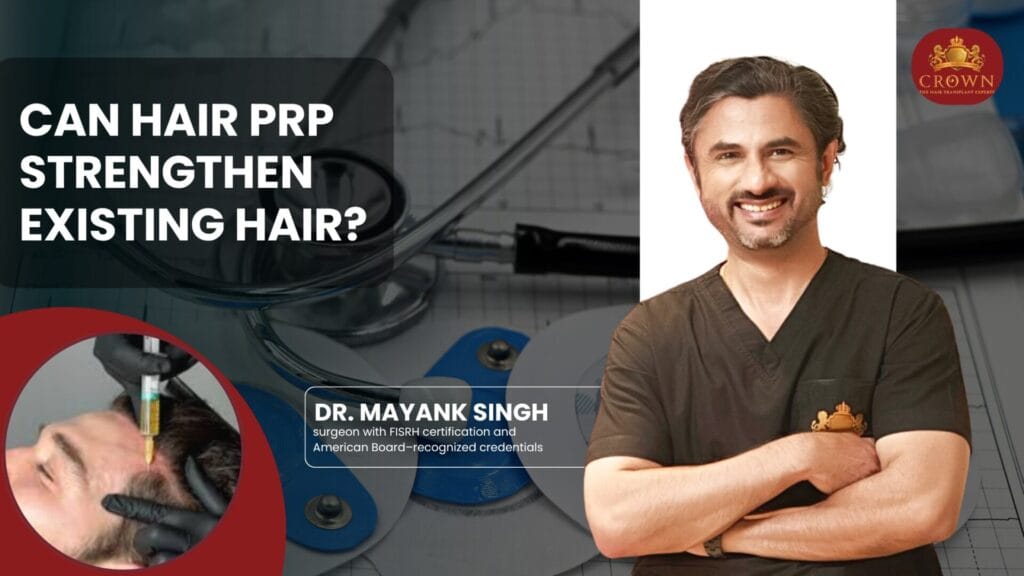
Hair PRP treatment strengthens existing hair by delivering concentrated growth factors directly to follicles that are still active but producing weaker, thinner strands. It does not create new follicles where none exist. The mechanism works on follicles that are present, alive, and responsive improving their function, extending their active growth phase, and increasing hair shaft thickness over the course of a structured treatment protocol.
According to Dr. Mayank Singh,
Hair PRP Treatment uses the body’s own growth factors to stimulate weakened follicles and improve overall hair strength progressively over time. “PRP is most effective when follicles are still present and the treatment begins before thinning has advanced too far.”
How Does Hair PRP Strengthen Existing Hair?
The treatment works through a specific biological mechanism. Understanding that mechanism clarifies what PRP can and cannot achieve for patients with thinning hair.
Growth factors stimulate follicle activity directly — A sample of the patient’s blood is processed to concentrate the platelets, which contain growth factors including PDGF, VEGF, and IGF. These are injected into the scalp at follicle depth. The growth factors activate stem cells around the follicle base, stimulating the follicle to produce hair more actively. At Crown Hair Transplant, platelet concentration and injection depth are both calibrated before each session.
Blood supply to roots improves — PRP injections increase vascularisation around the follicle. Better blood flow delivers more oxygen and nutrients to the follicle on an ongoing basis, improving the biological environment in which hair grows. Follicles that are consistently well-nourished remain active longer and produce stronger hair shafts.
Hair shaft thickness increases over the treatment course — Follicles that were producing thin, fine strands due to miniaturisation respond to PRP by producing progressively thicker hair across successive sessions. This is one of the most clinically measurable outcomes of a completed PRP course.
Active growth phase is extended — Growth factors in PRP prolong the anagen phase of the hair cycle, the active growth period. A longer active phase means less shedding and more time for each hair to reach full length and thickness before entering the resting stage.
For a comprehensive breakdown of what to assess before starting PRP, read our previous blog — What Should You Know Before Considering PRP?
Who Is the Right Candidate for Hair PRP?
PRP produces consistent results in specific patient profiles. Candidacy is determined by follicle status, stage of hair loss, and scalp condition at the time of assessment.
Early to mid-stage thinning responds most strongly — Patients who still have a reasonable density of active follicles at the crown, hairline, or mid-scalp get the most consistent response. The growth factor stimulus has more follicles to work with, and outcomes are proportionally stronger.
Stress and nutritional shedding responds well — Telogen effluvium caused by physical stress, illness, or nutritional deficiency pushes follicles into the resting phase. PRP reactivates those follicles and supports the return to normal cycling once the underlying cause has been addressed.
Post-transplant patients benefit from PRP support — FUE Hair Transplant patients who use PRP during the recovery period show improved graft survival and faster visible growth. The growth factors create a better biological environment for newly transplanted follicles to establish.
Completely inactive scalp areas do not respond — Where follicles have permanently ceased functioning and the scalp is smooth with no follicular units visible, PRP has no base to work from. A clinical scalp assessment identifies this before any treatment is recommended.
Why Choose Crown Hair Transplant for PRP?
Dr. Mayank Singh is the President of the Association of Hair Restoration Surgeons of India, a Diplomate of the American Board of Hair Restoration Surgery, and a Fellow of the International Society of Hair Restoration Surgeons. He is the only surgeon in India to have received the Shelly Friedman Award. For Hair PRP Treatment specifically, platelet processing concentration, injection depth, session spacing, and follow-up protocol all directly influence whether results are clinically meaningful or marginal. Each case at Crown begins with a full scalp evaluation. The treatment plan is built around follicle status, hair loss pattern, and scalp condition not a standard protocol applied uniformly to all patients presenting with hair thinning.
CTA:
📞 Call Now:.+91-9015112233 Schedule your consultation today. Same day appointments are available for patients experiencing sudden or aggressive hair thinning
FAQs
Most patients require 3 to 4 sessions spaced a few weeks apart.
Discomfort is mild and usually manageable without significant downtime.
It helps slow progression but does not permanently cure genetic baldness.
Visible strengthening typically appears after three to four months.