
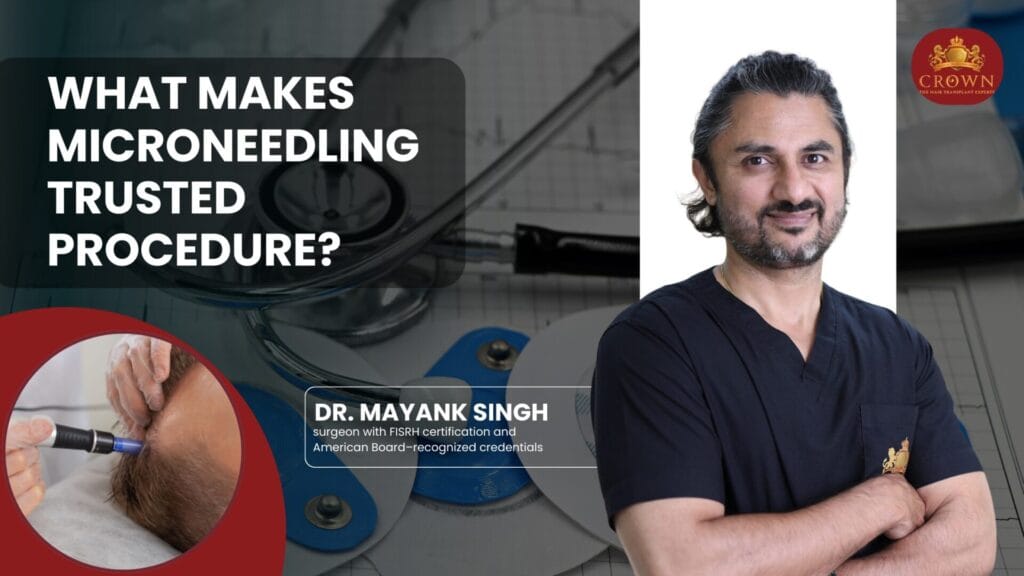
Microneedling has a clinical track record that most non-surgical procedures do not. It has been studied across different skin types, age groups, and conditions long enough for the results to be reproducible and well-documented. The trust it holds in dermatology and hair restoration practice is not based on trends. It is based on outcomes that have held up under repeated clinical scrutiny.
According to Dr. Mayank Singh,
Microneedling works because it triggers the skin’s own repair response rather than introducing any foreign substance. “That is precisely why results look natural and why the procedure has maintained its clinical reputation across decades of use.”
What Specifically Makes Microneedling Reliable?
The procedure is not complicated. But understanding why it performs consistently helps patients assess it with more clarity.
- It works with the body’s biology — Fine needles create controlled micro-injuries in the skin. The body responds by producing fresh collagen and elastin. No synthetic material is introduced. The repair mechanism is entirely the patient’s own. That is a significant reason why outcomes look natural rather than treated. Patients at Crown Hair Transplant have this assessed individually before any session plan is finalised.
- Results hold across different skin types — Certain laser treatments and chemical peels carry a risk of pigmentation changes in darker skin tones. Microneedling, when calibrated correctly, does not carry that same risk. It performs consistently across a wide range of skin tones. That predictability is part of its clinical value.
- Multiple concerns are addressed in one protocol — Acne scars, uneven texture, enlarged pores, fine lines, and loss of firmness all respond to the same collagen-stimulating mechanism. One planned course of sessions works across several concerns simultaneously rather than requiring separate treatments for each.
- Results accumulate progressively — Each session builds on the collagen produced in the previous one. Outcomes improve over the full course rather than peaking after one session and fading. That sustained progression is one of the main reasons patients return to it for long-term skin maintenance.
Should You Consider Microneedling for Scalp Treatment?
The scalp responds to microneedling in a very similar way to facial skin. For patients dealing with hair thinning or early hair loss, the clinical rationale is sound.
- Dormant follicle stimulation — The micro-injuries created during scalp microneedling send collagen-stimulating signals that activate weakened follicles. Follicles producing thin or slow-growing hair often respond after a properly planned course of sessions.
- Improved blood circulation to roots — Better blood flow brings more oxygen and nutrients to each follicle. Follicles that are consistently well-nourished stay active longer and produce stronger hair over time.
- Enhanced PRP absorption — When combined with Hair PRP Treatment, scalp microneedling allows growth factors to penetrate deeper into scalp tissue through the micro-channels created. The combined effect is measurably stronger than PRP applied to an untreated surface.
- Low downtime — Most patients return to daily activity within one to two days. That makes it a practical ongoing addition to a hair health plan without requiring extended recovery.
For a detailed breakdown of how microneedling supports collagen specifically, read our previous blog Does Microneedling Support Collagen Production?
Why Choose Dr. Mayank Singh for Microneedling
Dr. Mayank Singh is the President of the Association of Hair Restoration Surgeons of India, a Diplomate of the American Board of Hair Restoration Surgery, and a Fellow of the International Society of Hair Restoration Surgeons. For Microneedling specifically, his approach begins with a full skin and scalp assessment before any session plan is set. Skin type, sensitivity, treatment goals, and existing conditions are all reviewed first. Standard settings are not applied across patients. Whether the concern is skin rejuvenation, scar improvement, or scalp health maintenance, the protocol is built around what the individual patient’s skin requires at that point in time.
📞 Call Now:.+91-9015112233
Book your Treatment consultation at Crown Hair Transplant today. Same-day appointments available for urgent cases.
FAQs
Yes. When needle depth and session spacing are calibrated correctly, microneedling does not carry the pigmentation risk associated with certain laser treatments.
Most patients see meaningful improvement after three to six sessions spaced consistently over a planned course.
Topical anaesthetic is applied before the session. Most patients feel light pressure rather than pain during treatment.
Yes. Both respond well but face and scalp protocols are planned separately based on individual assessment.
Microneedling works through mechanical collagen stimulation using the body’s own repair response. Laser treatments use heat energy and carry a higher risk of pigmentation changes in certain skin types.