
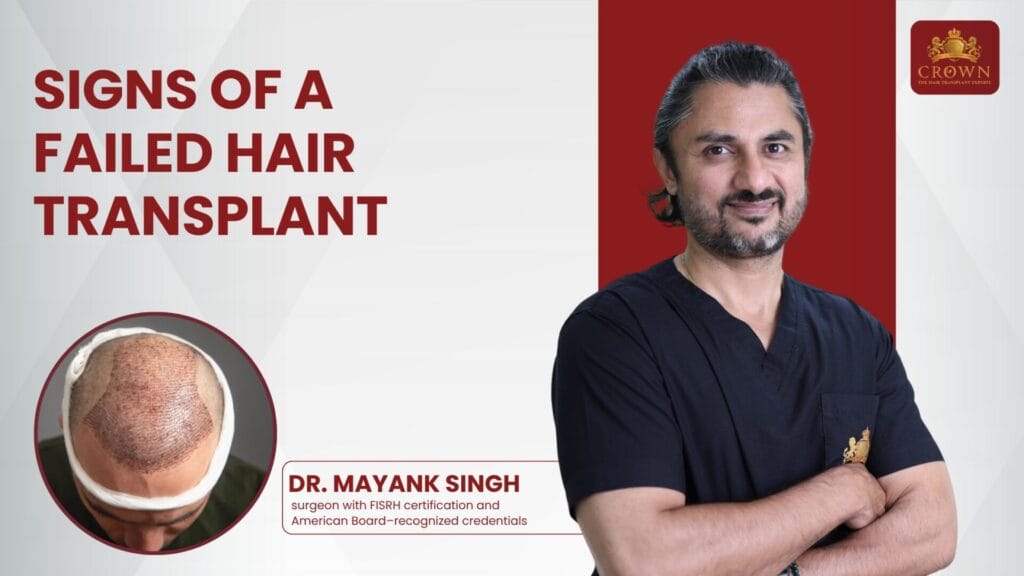
A failed hair transplant is not always immediately obvious. Some signs appear within weeks of the procedure. Others become apparent only after several months when expected growth fails to materialise. Recognising these signs early allows patients to seek clinical assessment promptly and understand what corrective options remain available. Delayed recognition consistently narrows the range of viable intervention pathways.
According to Dr. Mayank Singh, hair grafting failure is rarely a matter of chance. He explains that poor graft survival, unnatural results, and inadequate density are almost always traceable to compromised surgical planning, substandard graft handling, or insufficient pre-operative assessment at the time of the original procedure.
What Are the Primary Signs of a Failed Hair Transplant?
Identifying failure signs accurately requires understanding what a successful outcome looks like and where the deviation from that standard occurs.
- Absence of New Growth Beyond Six Months: Hair growth after a transplant procedure typically begins between three and four months post-surgery. If no visible new growth is present beyond the six-month mark a graft survival problem likely occurred during the original procedure and warrants immediate clinical assessment.
- Visibly Unnatural Hairline Design: An unnaturally straight hairline, excessively dense frontal placement, or grafts implanted without correct directional angulation produce results that appear clearly transplanted rather than natural. This outcome reflects inadequate surgical planning rather than a biological failure of the grafts themselves.
- Patchy or Inconsistent Density Across Treated Areas: Uneven density distribution with visible gaps or clustering in specific zones indicates graft placement errors or poor survival rates in affected areas. Consistent density across the treated zone is a fundamental marker of a properly executed Best Hair Doctor in Delhi level procedure.
- Persistent Redness or Scarring Beyond Normal Recovery: While temporary redness is expected in the immediate post-operative period its persistence beyond several weeks or the development of visible scarring in the recipient area suggests tissue damage, infection, or incorrect implantation depth during the original procedure.
- Shock Loss Without Subsequent Regrowth: Temporary shock loss of existing hair around the transplanted area is a known post-operative occurrence. When this shedding is not followed by regrowth within the expected timeframe it may indicate that surrounding native follicles sustained permanent damage during the surgical procedure.
What Causes Hair Transplant Failure and What Can Be Done?
Understanding causation is essential before evaluating corrective options. Failure rarely occurs without identifiable clinical reasons.
- Graft Mishandling During Extraction and Storage: Follicles exposed to incorrect storage conditions, excessive dehydration, or prolonged time outside the scalp experience significantly reduced viability. Compromised grafts implanted in the recipient area simply do not grow regardless of how precisely they are placed.
- Technician-Led Procedures Without Direct Surgeon Oversight: Procedures performed predominantly by technicians without qualified surgeon involvement throughout every critical stage carry measurable risk of graft damage, incorrect angulation, and inadequate depth control that collectively produce substandard outcomes.
- Inadequate Pre-Operative Candidacy Assessment: Patients transplanted without proper evaluation of donor density, hair loss progression stage, and scalp condition frequently experience results that fail to meet expectations because the procedure was undertaken without a realistic assessment of what the available donor supply could deliver.
- Corrective Assessment Must Precede Any Revision Decision: Patients suspecting transplant failure require a thorough clinical evaluation before any corrective procedure is considered. Donor reserve assessment, recipient area analysis, and honest outcome discussion are essential components of this evaluation without exception.
- Revision Surgery Is Possible in Appropriate Cases: When sufficient donor hair remains available and the scalp condition supports further intervention revision surgery can address density deficiencies, correct unnatural hairline design, and restore a more acceptable aesthetic outcome in carefully selected patients.
To understand what criteria patients should apply when selecting a surgeon for initial or revision procedures read our previous blog “Hair Transplant vs Hair Patch: Which Is Better Long Term?”
Why Choose Dr. Mayank Singh for Hair Transplant in Delhi?
Dr. Mayank Singh is a Diplomate of the American Board of Hair Restoration Surgery, Fellow of the International Society of Hair Restoration Surgery, and President of the Association of Hair Restoration Surgeons of India. Every procedure at Crown Hair Transplant is performed under his direct surgical supervision with thorough pre-operative assessment and structured post-operative monitoring throughout the growth period. Patients presenting for corrective assessment after procedures performed elsewhere receive the same standard of clinical evaluation and honest outcome discussion as all patients treated at the clinic.
Surgical outcomes that fall short of expectation are manageable in many cases when the correct clinical pathway is followed promptly and without delay.
Call Now: +91-9015112233. Book your consultation at Crown Hair Transplant today. Same-day appointments available for urgent cases.
FAQs
1. How early can signs of a failed hair transplant be identified? Some signs appear within weeks. Absence of growth beyond six months is the most definitive indicator of graft failure.
2. Can a failed hair transplant be corrected through revision surgery? Yes in appropriate cases. Donor reserve and scalp condition must be assessed before any revision procedure is recommended.
3. What is the most common cause of hair transplant failure? Compromised graft handling, technician-led procedures, and inadequate pre-operative assessment are the most frequently identified causes.
4. Should patients wait before seeking assessment after a suspected failed transplant? No. Early clinical assessment preserves more corrective options and prevents further unnecessary delay in addressing the outcome.