
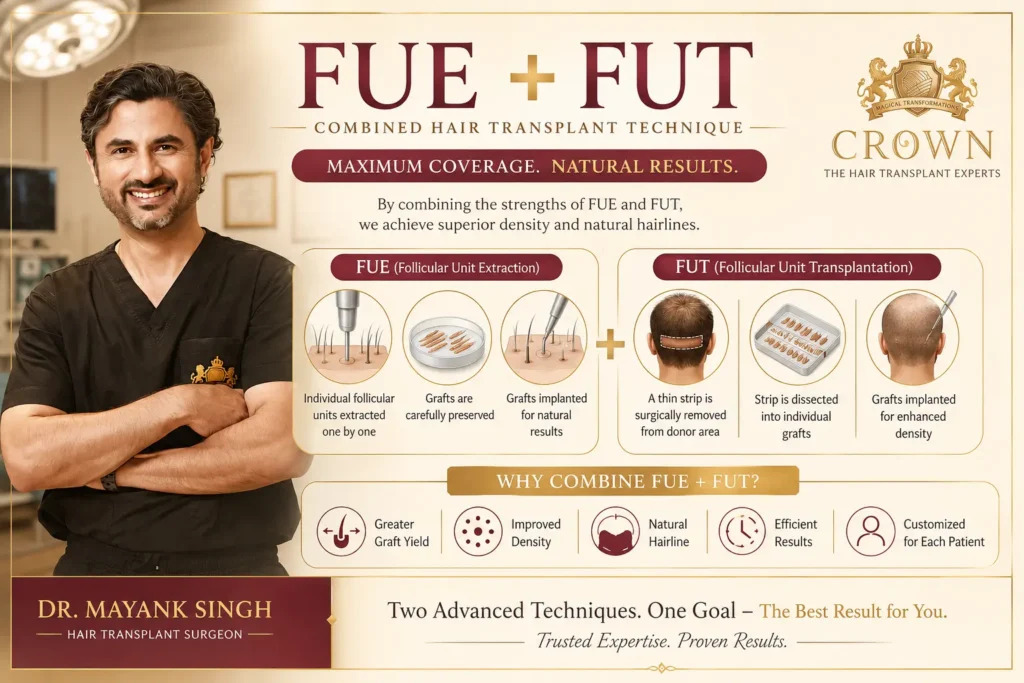
For the better part of a decade, most hair transplant conversations have been framed as a binary: FUE or FUT? The internet, patient forums, and a number of clinics have fortified this framing, often with a preference already baked in, because offering one technique efficiently is easier than mastering both.
“The debate between FUE and FUT has always been a false choice. Both techniques harvest from the same finite donor zone. A surgeon who only offers one of them is working with one hand behind their back and so is the patient.” — Dr. Mayank Singh, Crown Hair Transplant, New Delhi
But for patients with advanced hair loss, limited donor reserves, or a need for the highest possible graft count in a single surgical plan, the either-or framing isn’t just unhelpful. It can actively produce a worse outcome than a combined approach would have.
The combined FUE + FUT technique, using both methods within the same surgical plan, either in a single session or across staged sittings, is not a workaround or a compromise. When indicated and executed correctly, it is often the most powerful option available in hair restoration surgery.
Understanding What Each Technique Actually Contributes
Before understanding why the combination works, it helps to be precise about what each method does.
FUT (Follicular Unit Transplantation) involves removing a strip of skin from the permanent donor zone at the back of the scalp, dissecting it into individual follicular units under microscopy, and placing those units into the recipient area. It leaves a linear scar, which is manageable and easily concealed under normal hair length, but it allows a very high yield of grafts from the densest central portion of the donor zone in a single session, without disturbing the surrounding follicles.
FUE (Follicular Unit Excision) extracts individual follicular units one by one using a small punch tool, leaving scattered dot scars across the donor area rather than a linear scar. It’s the preferred technique for patients who wear their hair very short, and it allows harvesting from a wider area, including the sides and lower scalp, giving access to follicles that sit outside the FUT strip’s footprint.
Run individually, each has a ceiling, a maximum graft yield per session, and certain areas of the donor zone that one technique accesses less efficiently than the other. The combination removes both ceilings simultaneously.
When the Combined Approach Is the Right Plan?
The FUE + FUT combination is most relevant in these specific situations:
- Advanced hair loss (Norwood 5, 6, or 7): Where the total area needing coverage is large and a single-technique session cannot yield enough grafts to make a meaningful difference in density. The combined approach can increase the total graft count of a single surgical plan by 30–50% over what either method could achieve alone.
- Repair and revision cases: Patients arriving with a failed or incomplete transplant from elsewhere often have partially depleted donor zones. Combining techniques allows extraction from areas the original surgeon didn’t access, maximising what’s left in a compromised donor bank.
- Patients who want a single, definitive session: Rather than spacing across two or three separate FUE sessions over multiple years, a combined approach can consolidate the bulk of the work and the disruption to a patient’s life into one planned surgical event.
- High-density frontal restoration in a single pass: Where the frontal zone demands a graft count that FUE alone, with its per-session extraction limits, cannot comfortably deliver without overharvesting.
How the Surgical Planning Works in Practice?
The combination requires more detailed pre-operative mapping than either technique alone, because the surgeon is managing two distinct extraction zones simultaneously and needs to ensure neither is overtaxed.
At Crown, the planning process for a combined session typically involves:
- Trichoscopic donor assessment measuring density per square centimetre across the FUT strip zone and the surrounding FUE-accessible area separately, rather than averaging across the whole donor zone.
- Graft yield projections for both zones, calculating the realistic maximum from the strip and from peripheral FUE harvesting without thinning either area to the point of visible depletion.
- Recipient site planning first establishes the target graft count the restoration actually needs, and then working backwards to determine the extraction split between FUT and FUE that achieves it most efficiently.
- Donor zone preservation ensures the combined extraction plan leaves enough reserve for a future top-up session if the patient’s loss continues to progress, which in younger patients is always a realistic scenario to plan around.
The strip dissection and FUE extraction are typically performed sequentially rather than simultaneously, with the surgical team moving between techniques in a coordinated sequence that minimises total operative time and graft exposure before placement.
What Patients Should Expect
Recovery from a combined session differs slightly from a standalone FUE or FUT procedure:
- The linear scar from the FUT strip requires suture or staple removal at around ten days. With proper closure technique, trichophytic closure is the standard at Crown. The scar is designed to allow hair to grow through it, minimising its long-term visibility.
- The FUE donor zone heals faster, with scab formation resolving within the first week, and the dot-pattern extraction sites are generally invisible within a few weeks under normal hair length.
- Growth timeline is the same as any transplant; the transplanted hair sheds in the first four to six weeks, enters a resting phase, and begins meaningful growth from month three or four, with the final result not fully visible until twelve months post-surgery.
- Total graft survival is unaffected by the combination itself. Survival depends on graft handling, the speed of out-of-body time, and the quality of recipient site creation, none of which are compromised by using both extraction methods in the same session.
The Bottom Line
The combined FUE + FUT approach isn’t the right answer for every patient, but for those with advanced loss, a depleted donor zone, or a need for maximum coverage in a single well-planned session, it is often the most complete answer available.
At Crown Hair Transplant, Dr. Mayank Singh has built his surgical practice around precisely this kind of individualized planning, assessing each donor zone on its own terms rather than applying a one-technique-fits-all approach.
If you’re exploring your options for a first transplant or navigating a situation where a previous procedure hasn’t delivered what was promised, a detailed consultation is the right starting point.
Book a consultation with Dr. Mayank Singh at Crown Hair Transplant in Delhi for expert, personalised hair restoration guidance.
FAQs
Not inherently. The risks associated with each technique, scar visibility, donor thinning, and transection rate are managed independently. A well-planned combined session, with appropriate donor zone mapping, carries the same risk profile as two well-planned individual sessions performed separately.
It depends on the total number of grafts involved. Sessions targeting up to around 4,000–4,500 grafts combined are typically completed in a single, longer operating day. Higher counts may be staged over two days or two separate sittings, thereby maintaining graft quality throughout.
Less commonly, but yes, in selected cases. Female candidates with high grade loss requiring significant coverage are occasionally planned for combined sessions, though the more limited donor zones typical in female pattern loss make this less frequent than in male cases.
With trichophytic closure and proper wound management, the linear scar is typically not visible at hair lengths of 1cm or longer. Patients who wear hair very short, grade 1 or 2, may prefer FUE-only to avoid the scar entirely, which is one of the clinical factors weighed at the planning stage.