
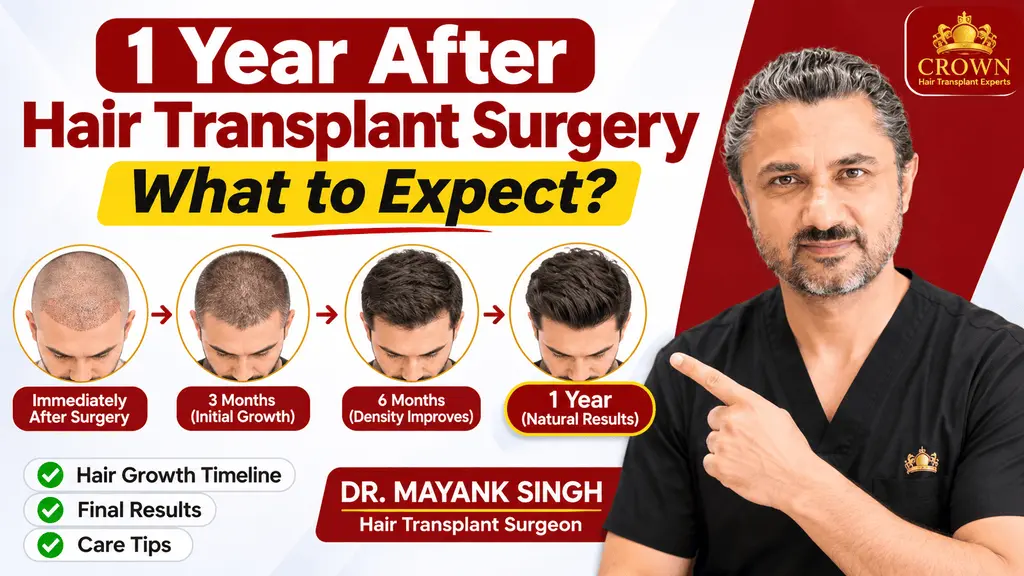
Twelve months is the threshold the hair restoration community uses when assessing transplant outcomes, and for good reason. It takes a full year for implanted follicles to complete their first growth cycle, for hair calibre to reach its mature thickness, and for the density of the result to stabilise. Before twelve months, what’s visible is a work in progress. At 12 months, there’s something worth evaluating.
“The twelve-month mark is when the real conversation happens. Not the one about what the result looks like today, but about whether it matches what we planned together before surgery and what, if anything, needs to come next. That conversation is only honest if the expectations were set correctly at the beginning.” — Dr. Mayank Singh, Crown Hair Transplant, New Delhi
For patients who have been through that year of shedding, the resting phase, the uneven early growth, the gradual improvement reaching this point carries its own kind of weight. Some arrive at the 12-month mark delighted. Others have questions. A few have concerns. This article explains what a mature result should look like, what variables influence it, and what options exist if expectations haven’t been met.
What a Well-Executed Result Looks Like at 12 Months
A technically successful hair transplant at twelve months should demonstrate the following:
- Density that achieves the pre-operative goal, not necessarily the density of a non-balding person, but sufficient coverage of the planned recipient zone to achieve the aesthetic improvement discussed during consultation.
- Natural direction and angle of all transplanted hairs, consistent with the surrounding native hair and appropriately following the scalp’s natural growth patterns.
- A hairline that reads as natural — not linear, not uniform, with micro-irregularity at the front edge and temporal angles that blend into the sides without visible demarcation.
- Hair calibre matching the donor — transplanted hairs should be indistinguishable from native hair in texture, wave, and thickness by this stage.
- Donor zone that shows no visible depletion — in a well-planned procedure, the extraction zone should appear full and undisturbed at normal hair lengths.
This is what a successful outcome looks like. Anything that meaningfully deviates from it deserves a careful, honest assessment.
Why Results Vary Between Patients
No two hair transplant results are identical, even when performed by the same surgeon using the same technique. The variables that determine density, growth rate, and overall outcome operate at a biological level that surgical skill alone cannot override.
- Graft survival rate: Most well-executed transplants achieve survival rates between 85% and 95%. A portion of grafts, even in the best-case scenario, will not survive the transplantation process. This is accounted for in planning by implanting a slightly higher graft count than the minimum required to achieve the target density.
- Hair calibre: Coarser hair covers more visual area per graft than fine hair. A patient with naturally fine, straight hair will have a different density-per-graft ratio than someone with medium or coarse hair, even with the same number of grafts placed in the same area. This is discussed in planning but continues to shape the final result in ways patients sometimes revisit at twelve months.
- Scalp laxity and vascularity: A scalp with good blood supply heals more efficiently, supports faster graft vascularisation, and tends to produce stronger early growth. Factors including smoking history, certain medications, and pre-existing scalp conditions affect this.
- Age and ongoing hair loss: Patients who had surgery in their 20s or early 30s may notice, at twelve months, that native hair in adjacent areas has continued to thin, creating a contrast between the restored zone and the surrounding scalp that wasn’t visible before surgery. This is not a failure of the transplant; it’s the natural progression of androgenic alopecia continuing around a result that is permanently stable.
Common Questions Patients Have at 12 Months
“The density isn’t quite what I expected.” This is the most frequent concern at the twelve-month review and deserves an honest, structured answer. The first question is whether the result is within the range that was realistically projected before surgery. If the target was communicated clearly in consultation and the outcome is short of it, a trichoscopic assessment can determine whether the shortfall is due to lower-than-expected graft survival, natural variation in growth, or a planning issue.
If there is a genuine density gap, options include a second session to add grafts to the underperforming areas, though this is typically not considered until at least 12 to 14 months post-surgery to ensure all growth from the first session has been realised.
“Some areas grew better than others.” Uneven density across the recipient zone is common in the first 6 to 9 months and usually resolves as slower-cycling follicles catch up. At 12 months, persistent unevenness that doesn’t follow the natural variation of the hair growth cycle is worth reviewing; it can indicate localised areas of lower graft survival that may benefit from targeted secondary work.
“My hairline looks natural, but the crown didn’t fill in as much.” The crown is consistently the most difficult area to restore to high density. Grafts placed in the crown grow in a spiral pattern that demands very precise angle placement, and the visual impression of density in this area is affected significantly by the circular growth direction.
Additionally, the crown is often given lower priority in planning to preserve donor reserve, particularly in younger patients where future loss around it remains likely. This is a conversation that should have been had before surgery, but if it wasn’t, it’s worth having now.
The Role of Medical Therapy at 12 Months
By the 12-month mark, any patient on finasteride or minoxidil pre-operatively should still be taking it. These medications don’t protect transplanted hair, which is already DHT-resistant, but they do protect the surrounding native hair that continues to be susceptible to androgenic miniaturisation.
Stopping medical therapy after a successful transplant is one of the most common mistakes patients make. The result at 12 months looks complete, the urgency of treatment feels reduced, and adherence drops. The consequence is a gradual thinning of native hair around the transplanted zone that creates, over the following years, a visible contrast between the permanently dense restored area and the receding native hair surrounding it.
When a Second Session Makes Sense
A second hair transplant session, whether to increase density in the primary zone, extend coverage to a new area, or address the progression of loss beyond the original transplant’s scope, is a genuine and planned-for possibility that most patients with moderate to advanced hair loss will eventually consider.
The conditions for a responsible second session at or after twelve months are:
- The first result has fully matured and been assessed
- The donor zone has recovered adequately and has sufficient remaining reserve
- The reason for a second session is clear, whether density enhancement, coverage extension, or addressing ongoing loss
- Medical therapy has been maintained to minimise the ongoing loss that necessitates further surgery
A second session on a well-managed donor zone, planned conservatively, can produce results that match or exceed the first. The key word is planned, treating the donor zone as a resource to be managed over the long term, not spent in a single transaction.
Conclusion
One year after hair transplant surgery is a milestone worth marking both as an honest assessment of the result and as a starting point for planning whatever comes next. The transplanted follicles are permanent. The result is stable. The question at 12 months is not whether the transplant worked but whether the outcome achieved its goals and what, if anything, is worth doing to build on it.
At Crown Hair Transplant, twelve-month reviews are a standard part of the patient journey not a courtesy call, but a structured clinical assessment that informs decisions about maintenance, further treatment, and long-term hair health. If you’re approaching the one-year mark after a transplant performed elsewhere and want an independent, honest evaluation of your result, we offer dedicated review consultations for exactly this purpose.
Book your twelve-month review or consultation with Dr. Mayank Singh at Crown Hair Transplant, New Delhi.
Book a consultation with Dr. Mayank Singh at Crown Hair Transplant in Delhi for expert, personalised hair restoration guidance.
FAQs
The transplanted follicles are permanent; they are genetically DHT-resistant and will not follow the same loss pattern as the hair that was lost. What continues to change is the surrounding native hair, which remains susceptible to androgenic alopecia and continues thinning unless managed medically.
A twelve-month review with trichoscopic assessment is the right starting point. It can identify whether the shortfall is within the normal range of variation, a graft survival issue, or a planning-related gap. Based on that assessment, options including a secondary session can be discussed if appropriate.
Yes. By twelve months, transplanted follicles are fully established, and the scalp is completely healed. Chemical treatments including colour, relaxers, and perms can be used normally at this stage, though it’s worth testing a small area first if the scalp felt sensitive during recovery.
Most surgeons, including at Crown, recommend waiting at least twelve to fourteen months after the first session before considering a second. This allows the full result of the first session to be assessed, the donor zone to recover, and the second session to be planned based on the actual outcome rather than a partial one.
Yes, if they were appropriate for you before surgery. These medications protect native hair, not transplanted hair. Stopping them after a successful transplant removes the protection from the surrounding hair and accelerates the natural loss that the transplant cannot cover.
Some temporary thinning in the donor zone is common during recovery but should be largely resolved by twelve months. If thinning persists visibly at this stage, particularly with FUE, where overharvesting is the most common cause, it’s worth a trichoscopic review to assess density and determine whether further extraction from that area is advisable in any future session.
Other patients’ results are useful for setting general expectations, but they cannot substitute for understanding your own case. Hair calibre, scalp characteristics, the degree of loss, the graft count placed, and the specific zones treated all vary enormously between patients. The only meaningful benchmark for your result is the pre-operative discussion and the goals agreed upon in your own consultation.