
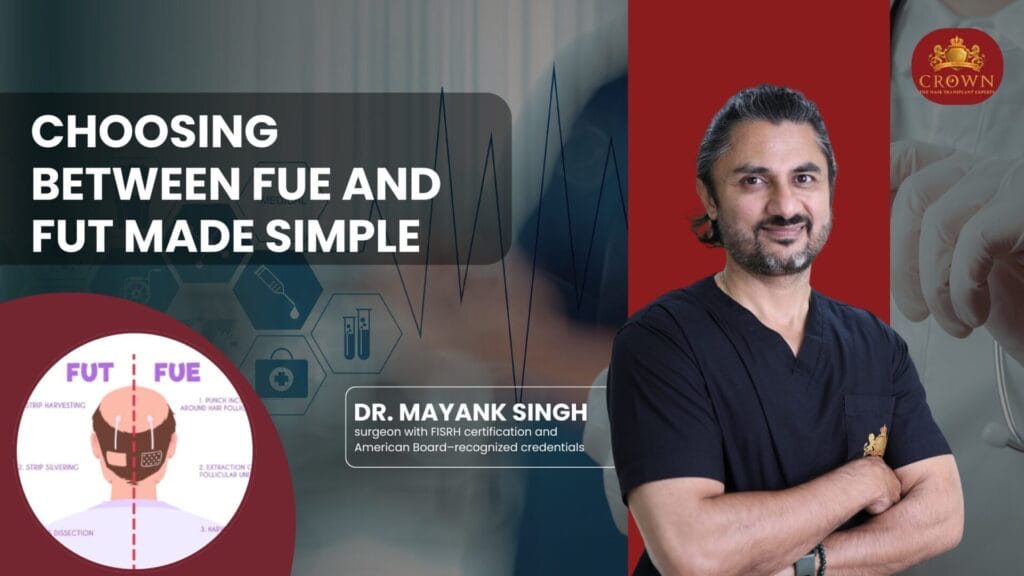
Selecting the right hair transplant technique can feel overwhelming, especially when both FUE (Follicular Unit Extraction) and FUT (Follicular Unit Transplantation) are proven methods for restoring hair. Each procedure offers unique advantages depending on hair loss severity, donor strength, and personal preferences. Understanding these differences helps patients make confident, well-informed decisions for long-term hair restoration.
According to Dr. Mayank Singh,
The choice between FUE and FUT should always be guided by scalp condition, graft requirements, and future hair loss patterns rather than trends alone. A personalized evaluation ensures the selected technique delivers natural density while preserving donor hair for potential future needs.
What Is the Core Difference Between FUE and FUT?
Both procedures aim to relocate healthy follicles from the donor area to thinning regions, but the extraction methods differ significantly.
- Extraction technique:
FUE removes individual follicles using micro punches, whereas FUT involves removing a thin strip of scalp for graft harvesting. The approach impacts healing, scarring, and the total number of grafts available. - Scarring pattern:
FUE leaves tiny dot-like marks that are difficult to detect, while FUT may result in a fine linear scar that is usually concealed beneath longer hair. - Procedure duration:
FUE may take longer due to the precision required for individual extraction. FUT often allows faster harvesting when a large number of grafts are needed. - Suitability based on hair loss:
FUT is often recommended for extensive baldness requiring maximum graft yield, while FUE works well for mild to moderate thinning.
To understand graft capacity better, read “FUT Hair Transplant for Severe Hair Loss”
Which Technique Offers More Natural Results?
At crown hair transplant When performed by experienced surgeons, both FUE and FUT can deliver highly natural outcomes. The success largely depends on planning and implantation expertise.
- Customized hairline creation:
Surgeons design the hairline according to facial symmetry and age to avoid an artificial appearance. - Strategic graft distribution:
Balanced placement ensures density where needed while maintaining a realistic transition from the hairline to the mid-scalp. - Correct angle and direction:
Grafts are implanted following natural growth patterns so the transplanted hair blends seamlessly. - Long-term aesthetic planning:
Considering future hair loss helps maintain a consistent look as the patient ages.
- Customized hairline creation:
Why Choose Dr. Mayank Singh for FUE and FUT Treatment Guidance?
At Crown Hair Transplant, treatment planning focuses on medical assessment rather than a one-size-fits-all approach. Dr. Mayank Singh, an experienced Hair Transplant Surgeon, evaluates scalp flexibility, donor strength, and hair loss progression before recommending the most suitable method.
Patients should consider consultation when hair thinning becomes noticeable, the hairline begins receding, or previous treatments fail to deliver improvement. With the right guidance, choosing between FUE and FUT becomes simpler, safer, and aligned with long-term hair restoration goals.
FAQ's
Both are safe when performed by qualified surgeons; the choice depends on individual needs.
Yes, FUT often allows harvesting a larger number of grafts in one session.
FUE typically involves quicker healing due to its minimally invasive nature.
Yes, transplanted follicles are generally resistant to pattern baldness.