
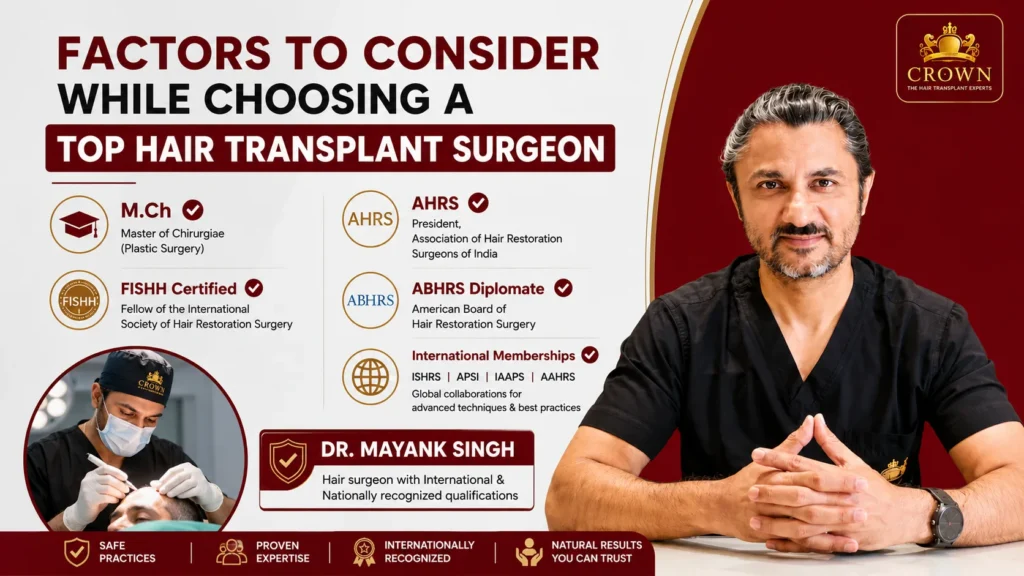
Hair transplant surgery has become widely available, and that availability has created a problem. Walk into any major Indian city, and there are dozens of clinics offering the procedure, many with similar-looking websites, similar before-and-after galleries, and similar promises. What’s far less visible to a first-time patient is the gap in skill, training, and judgment standing behind those results. This gap doesn’t show up until months after surgery, when a poorly executed transplant can’t simply be undone.
“Patients research clinics. They should be researching surgeons. The building, the brochure, the before-and-after gallery, all of that sits downstream of one decision: whose hands are actually doing the procedure, and what’s their track record built on?” — Dr. Mayank Singh, Crown Hair Transplant, New Delhi
Top Factors to Look For
Choosing a surgeon is, in effect, a one-shot decision. Donor hair is finite. A bad result doesn’t just fail to fix the problem; it consumes grafts that could have been used correctly. The following factors separate a qualified surgeon from someone performing procedures without the depth to handle complications, assess candidacy accurately, or design results that age well.
1. Formal Qualifications and Specialisation
The first filter, and the one most patients skip, is whether the person performing the surgery is actually a qualified surgeon with dedicated training in hair restoration, not a general physician who attends a weekend course and starts offering the procedure.
Look for:
- Board certification in hair restoration, such as ABHRS (American Board of Hair Restoration Surgery), a credential earned through written and oral examination, not a fee-paid membership.
- Fellowship status with recognised bodies, like FISHRS (Fellow of the International Society of Hair Restoration Surgery), which requires a documented case history and peer review, not just attendance.
- A medical degree with surgical training, since hair transplant is a surgical procedure involving anaesthesia, tissue handling, and the management of potential complications, all of which require formal medical grounding, not cosmetic-course certification alone.
It’s worth asking directly, in consultation, who holds these credentials and what they actually involve. Many clinics list “ISHRS member” prominently, but membership and board certification are not the same thing, and the difference matters.
2. Years of Hands-On Surgical Experience
Credentials establish a baseline. Experience is what separates a competent surgeon from an exceptional one, particularly because hair transplant surgery has a long learning curve. Graft survival rates, angle accuracy, and density planning all improve measurably with case volume, especially across the first several thousand procedures.
A few practical questions worth asking:
- How many years has the surgeon personally been performing hair transplants, not “the clinic,” the individual surgeon?
- Does the surgeon perform the technically demanding parts of the procedure (extraction, recipient site creation, hairline design) personally, or is this delegated to technicians?
- Has the surgeon handled complex or revision cases, repair work on transplants gone wrong elsewhere, which typically only comes to surgeons trusted for advanced-level skill?
Dr. Mayank Singh’s profile is built across more than a decade, with tens of thousands of procedures done. It includes a significant share of complex repair and revision cases referred from other clinics. This reflects a kind of depth, a sort of experience that only accumulates through sustained, hands-on practice rather than supervisory oversight.
3. International Recognition and Peer Standing
Beyond formal certification, standing within the broader hair restoration community is a meaningful signal, because that community is small, global, and self-policing in ways that matter to patients even if they never see it directly.
Relevant markers include:
- Leadership roles in recognised societies, such as AHRS (Association of Hair Restoration Surgeons), which require sustained contribution and peer respect, not just paid membership.
- Awards judged by international peers, such as the Shelly Friedman Award, recognition that comes from other surgeons evaluating documented surgical outcomes, not from marketing submissions.
- Speaking and teaching engagements at international hair restoration conferences, which generally only go to surgeons whose techniques and results other surgeons consider worth learning from.
These markers matter because they’re externally validated. A clinic’s own website can claim anything. A leadership position within AHRS, or an award judged by an international panel, can’t be self-awarded.
‘Dr. Mayank Singh currently serves as President of AHRS India, a position that reflects not just membership or participation, but elected leadership within the country’s foremost professional body for hair restoration surgery.’
4. Documented, Verifiable Patient Outcomes
Photographs are easy to curate. What’s harder to fake is a consistent pattern of natural-looking results across a wide range of cases, different hair types, different ages, different degrees of loss, visible not just in a handful of best-case galleries but across a large body of work.
Worth examining:
- Diversity of cases shown does the surgeon show results across Norwood stages 2 through 7, or only the easier, lower-graft-count cases that flatter any technique?
- Follow-up duration results photographed at 12+ months are far more meaningful than results at four or five months, since hair transplant growth isn’t fully mature until closer to a year.
- Revision and repair cases result in a surgeon willing to show repair work on transplants performed elsewhere, demonstrating both skill and confidence that’s harder to fake than a standard before-and-after pair.
- Independent reviews, beyond what’s curated on the clinic’s own site, Google reviews, patient testimonials on independent platforms, and word-of-mouth within hair loss communities.
Why This Combination Matters More Than Any Single Factor?
No single credential, on its own, guarantees a good outcome. A board certification confirms baseline competence but says nothing about current skill level. A high case volume means little if results are inconsistent.
The strongest indicator is the combination of formal qualification, sustained hands-on experience, peer recognition from the surgical community, and a track record of outcomes that holds up under scrutiny, not just in a handpicked gallery.
Final Thoughts
Choosing a hair transplant surgeon shouldn’t come down to price, package offers, or the number of grafts being advertised.
Instead, focus on the factors that truly influence your outcome: the surgeon’s qualifications, clinical experience, professional credentials, treatment philosophy, and the consistency of patient results.
Hair transplantation is a lifelong investment. Taking the time to choose the right hair transplant surgeon can make the difference between a result that simply adds hair and one that looks completely natural for years to come.
Want to get on a consultation? Let’s get in touch!
Book a consultation with Dr. Mayank Singh at Crown Hair Transplant in Delhi for expert, personalised hair restoration guidance.
FAQs
No, it’s not a legal requirement, which is precisely why it functions as a useful differentiator. Surgeons who pursue it voluntarily are signalling a higher standard of training than the minimum legally required.
Generally, yes, but it should be evaluated alongside outcome quality, not in isolation. High case volume with inconsistent results is less meaningful than a slightly lower volume with consistently natural outcomes.
Ideally, yes. In some larger clinics, the consultation is conducted by one doctor while the actual procedure is performed primarily by technicians under loose supervision. It’s reasonable and advisable to confirm who will actually be performing the surgery.
Most certifying bodies, including ABHRS and ISHRS, maintain searchable member directories. It takes a few minutes to confirm a credential directly rather than relying solely on what’s listed on a clinic’s website.