
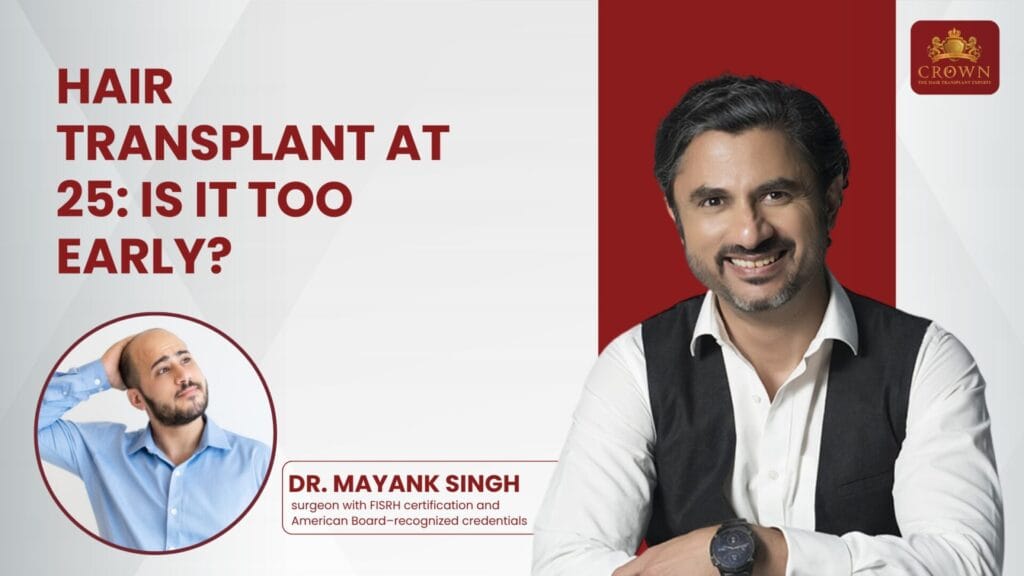
Age 25 is not an automatic disqualification for hair transplant surgery. It is however a stage at which proceeding without thorough clinical evaluation carries measurably higher risk than at a more advanced and stable hair loss stage. The central clinical concern at this age is not the patient’s capacity to undergo surgery. It is the unpredictability of ongoing hair loss progression and the long-term implications of committing donor resources at a stage when the full extent of future loss has not yet become apparent.
According to Dr. Mayank Singh, FUE hair transplant at age 25 requires a fundamentally different pre-operative assessment framework from cases presenting at 35 or 40. He explains that donor management, hairline design conservatism, and long-term progression planning carry significantly more weight in younger patients than in those whose hair loss pattern has already reached a stable and predictable stage.
Why Does Age 25 Require More Careful Clinical Evaluation?
Several clinical realities specific to younger patients make pre-operative assessment at this age more complex and consequential than standard hair transplant evaluation.
- Hair Loss Progression Is Frequently Incomplete at 25: Male pattern baldness typically continues progressing through the late twenties and into the thirties and beyond. A patient presenting at 25 with moderate frontal recession may develop significantly more extensive loss over the following decade. Surgical restoration designed around the current loss pattern may appear inadequate as future thinning advances into untreated areas.
- Hairline Design Carries Long-Term Consequences: A low and defined hairline designed for a 25-year-old face requires sufficient donor reserves to maintain its appearance as surrounding native hair continues thinning with age. Designing a youthful hairline without planning for future loss creates a result that looks natural at 25 and increasingly inconsistent by 40.
- Donor Reserve Must Support a Lifetime of Restoration Needs: The total donor supply available across a patient’s lifetime is finite. Allocating a significant proportion of that supply at 25 reduces the reserves available for future sessions addressing additional loss in subsequent decades. Conservative Hair Transplant Surgeon in Delhi level donor management at this stage is a clinical obligation rather than a preference.
- Family History Informs Long-Term Projection: Parental and grandparental hair loss patterns provide meaningful data for projecting the likely extent of future loss in a 25-year-old patient. This information is a required component of pre-operative assessment at this age and directly influences the surgical plan developed before any procedure is confirmed.
- Medical Management Should Precede Surgical Consideration: Patients presenting at 25 with active and progressive hair loss are typically assessed for medical management options including finasteride and minoxidil before surgical intervention is recommended. Stabilising progression through medical management first produces more reliable long-term surgical outcomes than operating during an active loss phase.
What Clinical Criteria Support Surgery at 25 in Appropriate Cases?
Surgical hair restoration at 25 is not categorically inappropriate. Specific clinical circumstances support proceeding when they are clearly established during evaluation.
- Stable Hair Loss Pattern With Clear Donor Availability: Patients who demonstrate a stable hair loss pattern confirmed over a period of observation and supported by adequate donor density may be suitable surgical candidates at 25. Stability rather than age is the more clinically meaningful determinant of surgical appropriateness.
- Localised Loss With Predictable Boundaries: Patients presenting with clearly defined and localised loss such as temporal recession or hairline recession without diffuse thinning may be appropriate candidates when the loss pattern is stable and donor supply is sufficient to support a conservative and well-planned restoration.
- Realistic Long-Term Expectations Are Clearly Established: A 25-year-old patient proceeding with surgery must fully understand that additional procedures may be required as loss progresses and that the current procedure addresses only the loss present at this stage. This expectation must be established explicitly during consultation before any commitment is made.
- Conservative Hairline Design Reflects Long-Term Planning: Hairline design for a 25-year-old patient must reflect age-appropriate conservatism that accommodates likely future progression rather than maximum youth restoration. A hairline designed with future loss projection in mind consistently produces more sustainable long-term outcomes.
- Ongoing Medical Management Continues Post-Surgery: Surgical restoration does not halt hair loss in non-transplanted areas. Continuing appropriate medical management after surgery is a clinical recommendation for younger patients to slow progression in untreated zones and protect the sustainability of the surgical result over time.
To understand the clinical criteria that determine surgical candidacy across different patient profiles read our previous blog “Can Body Hair Be Used for Hair Transplant?”
Why Choose Dr. Mayank Singh for Hair Transplant in Delhi?
Dr. Mayank Singh is a Diplomate of the American Board of Hair Restoration Surgery, Fellow of the International Society of Hair Restoration Surgery, and President of the Association of Hair Restoration Surgeons of India. Young patients presenting for assessment at Crown Hair Transplant receive a thorough evaluation of hair loss progression, family history, donor reserve, and long-term restoration planning before any surgical recommendation is made. The consultation process at this age is designed to ensure that proceeding with surgery serves the patient’s long-term interests rather than addressing only the immediate concern.
Proceeding at the right time with the right plan consistently produces better lifetime outcomes than proceeding early without adequate planning.
FAQs
1. Is 25 too young to undergo hair transplant surgery? Not categorically. Stability of hair loss pattern and donor availability are more clinically relevant than age alone.
2. Why is hairline design more conservative for younger hair transplant patients? Future hair loss progression must be planned for. A conservative design accommodates ongoing thinning and remains appropriate over time.
3. Should a 25-year-old try medical treatment before considering hair transplant surgery? Yes. Stabilising progressive loss through medical management before surgery typically produces more sustainable long-term outcomes.
4. Will a hair transplant at 25 require additional procedures in future years? In most cases yes. Future loss in untreated areas is likely and additional sessions may be required as hair loss continues progressing.