
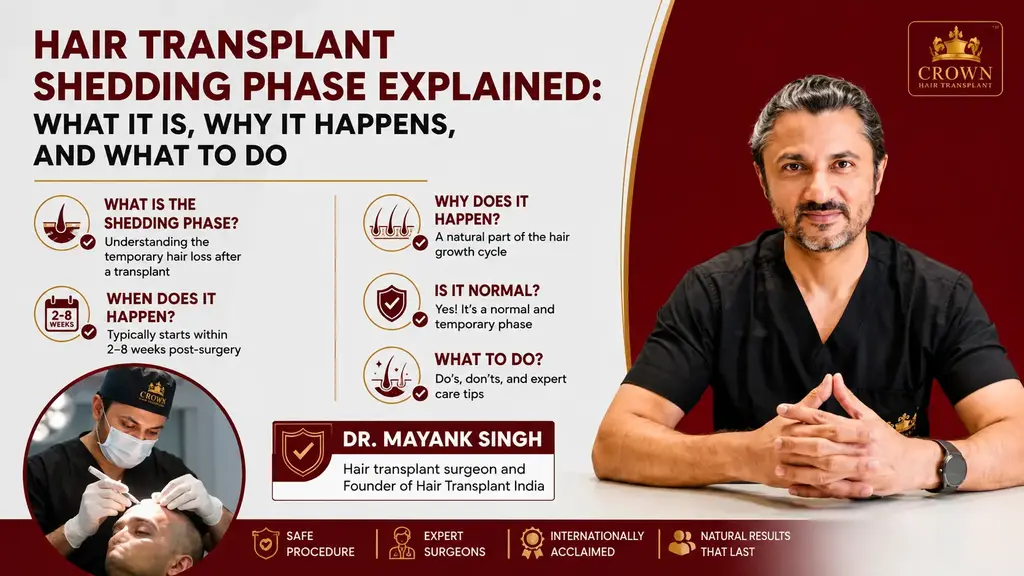
Hair transplant surgery ends in the operating chair, but the real test begins in the weeks that follow. For many patients, the most unsettling part of that period isn’t the swelling or the scabbing; it’s watching the transplanted hair fall out. They came in with thinning hair, sat through a full surgical day, and now the newly placed grafts are shedding. It feels, to almost every patient who hasn’t been prepared for it, like something has gone wrong.
“The shedding phase is the part of the process that undoes the most patients emotionally, not because it’s dangerous, but because nobody prepared them for it properly. I consider that a failure of the consultation, not the surgery. Every patient leaving Crown knows this is coming, what it means, and why it is actually a sign that the procedure is progressing exactly as it should.” — Dr. Mayank Singh, Crown Hair Transplant, New Delhi
It hasn’t. The shedding phase is not a complication. It is a fixed and necessary part of how hair transplant results develop, and understanding why it happens makes it considerably easier to get through.
What Is the Hair Transplant Shedding Phase?
The shedding phase, sometimes called shock loss or effluvium, refers to the period typically beginning two to four weeks after surgery when the transplanted hair shafts fall out. This happens because the follicular unit grafts, once placed into the recipient sites, respond to the stress of transplantation by entering a resting phase known as telogen.
The hair shaft itself is shed. The follicle, which is what actually produces regrowth, remains intact beneath the scalp. This is the distinction that matters most: losing the hair strand is not the same as losing the follicle.
The follicles then remain in telogen for approximately eight to twelve weeks before re-entering the active growth phase (anagen), at which point new hair begins to emerge from the same implanted units.
Why Does Shedding Happen After a Hair Transplant?
The mechanism is well established in hair restoration literature. When follicular units are extracted from the donor zone and placed into recipient sites, they undergo a period of ischaemia, a temporary reduction in blood supply before the surrounding scalp tissue vascularises and begins supporting them. The follicle’s response to this metabolic disruption is to shed the existing hair shaft and conserve energy until circulation is re-established.
This is the same biological response that occurs with other forms of hair loss triggered by physical stress, including major surgery, high fever, or significant nutritional deficiency. In transplant patients, it is controlled, expected, and temporary.
When Does Shedding Start and How Long Does It Last?
The timeline varies between patients, but the general pattern is consistent:
- Weeks 1–2: Transplanted hairs remain in place, scabs form, and gradually resolve around the implantation sites.
- Weeks 2–6: The shedding phase begins. Transplanted hair shafts fall out, often in noticeable numbers. This is the period most patients find distressing.
- Weeks 6–12: The scalp enters a resting phase. Little visible change occurs. This is the hardest period psychologically; the transplanted area can look sparse, and progress feels invisible.
- Months 3–4: New hair begins to emerge from the implanted follicles. Initial growth is fine and sometimes lighter in colour than mature hair.
- Months 6–9: Density improves progressively and hair shaft calibre increases.
- Month 12 onwards: The final result becomes visible. Some patients, particularly those with coarser or slower-cycling hair, may see continued improvement up to eighteen months.
Does All the Transplanted Hair Shed?
Not always, and not equally. Some patients lose the majority of transplanted hairs within the first month. Others shed more gradually, with some hairs appearing to persist through much of the resting phase before eventually cycling out and regrowing. Both patterns are normal.
What does not vary is that the follicle itself should not be lost during this phase, provided the grafts were handled correctly during surgery, placed at the right depth and angle, and allowed to settle without being disturbed during the critical first ten days post-operatively.
Shock Loss in the Native Hair: A Separate But Related Phenomenon
Alongside shedding of transplanted grafts, some patients experience temporary thinning of existing native hair in or around the recipient zone. This is called shock loss, and it occurs because the surgical trauma of recipient site creation can temporarily disrupt the resting/active cycle of hair follicles that were already present in the area.
Shock loss in native hair is almost always reversible. The follicles are not damaged; they are temporarily shocked into telogen. They typically recover and re-enter the growth phase within three to six months. In patients with very fine, miniaturised hair in the recipient area, common in those with more advanced androgenic alopecia, shock loss may occasionally unmask pre-existing fragility that would have progressed regardless.
This is one reason why pre-operative scalp assessment at Crown includes an evaluation of native hair density and miniaturisation in the recipient zone, so patients understand what is pre-existing and what is surgical in origin.
What to Do and Avoid During the Shedding Phase
Managing the shedding phase is largely about restraint: avoiding the things that can compromise graft survival during a period when the follicles are vulnerable.
Continue as directed:
- Take prescribed medications as scheduled, including any anti-inflammatory medication in the first week and minoxidil if it has been part of the pre-operative plan.
- Gentle washing with the recommended solution from day three or four onwards, as directed at discharge.
- Sleep with the head elevated for the first week to minimise forehead oedema migrating toward the recipient zone.
- Protect the scalp from direct sun exposure for at least the first four weeks.
Avoid:
- Scratching, picking, or forcibly removing scabs or grafts in the first ten days are mechanically anchored but not yet vascularised, and physical disruption can dislodge them.
- Strenuous exercise or activities that produce heavy sweating for the first two weeks.
- Swimming pools, saunas, and steam rooms for at least one month.
- Applying any topical product to the recipient zone that has not been specifically approved by the surgical team.
- Making aesthetic judgements about the result before the twelve-month mark. No reliable assessment of density, coverage, or growth pattern is possible before that point.
When Should Shedding Concern You?
Most shedding is entirely normal and self-limiting. There are, however, situations that warrant contact with the clinic:
- Signs of infection — increasing redness, warmth, swelling, or discharge from the recipient or donor zone after the first week.
- Persistent folliculitis — small, pustular spots around the hair follicles that don’t resolve spontaneously within a few days.
- Visible graft loss in the first week — if grafts appear to be dislodging in the first seven to ten days, this needs to be reviewed.
- Complete absence of any regrowth by month five or six — while timelines vary, a total absence of any visible new growth at this stage is worth discussing with the surgeon.
Conclusion
The shedding phase is not a setback. It is the procedure working exactly as it should. The follicles placed during surgery are not destroyed when the hair shafts fall out; they are resting, re-establishing their blood supply, and preparing to produce the permanent growth the entire procedure was designed for.
Patience is the most demanding part of hair transplant recovery, and the shedding phase is its sharpest test. At Crown, patients are counselled through every stage of this timeline in detail before the procedure takes place because understanding what is happening and why is the most effective way to get through it without unnecessary anxiety.
If you’re considering a hair transplant and want to understand the full recovery process before committing to surgery, book a consultation with Dr. Mayank Singh at Crown Hair Transplant, New Delhi.
Book a consultation with Dr. Mayank Singh at Crown Hair Transplant in Delhi for expert, personalised hair restoration guidance.
FAQs
Yes, in most cases. The shedding of transplanted hair shafts in the first two to six weeks is a normal biological response to the stress of transplantation. The follicles remain intact beneath the scalp and will produce new hair growth as they re-enter the active phase.
No. Shedding of the hair shaft is not the same as losing the follicle. A follicle that sheds its shaft during the telogen phase will re-enter growth and produce new hair. True graft failure, where the follicle itself does not survive, is caused by surgical factors such as poor graft handling, desiccation, or incorrect placement depth, not by the normal shedding process.
The timeline is largely biologically determined. Minoxidil, if not already in use, is sometimes introduced post-operatively to support the re-entry of follicles into the growth phase. Platelet-rich plasma (PRP) sessions at three and six months post-surgery are used at Crown for the same purpose. No topical product can force follicles out of telogen ahead of their natural cycle, but these interventions can support the conditions for earlier and stronger growth.
Some patients experience temporary thinning of existing hair in and around the recipient zone; this is called shock loss. It is caused by surgical disruption to the local hair cycle and is almost always reversible within three to six months.
Permanent graft loss results in a visible bald patch that does not recover. Shedding during the telogen phase results in temporary sparseness that resolves with regrowth. If there is uncertainty about whether an area is experiencing normal shedding or true graft loss, a trichoscopic assessment at around four to five months post-surgery can help differentiate the two.
No. Growth timelines after hair transplant vary considerably between individuals, driven by differences in hair cycle length, donor hair characteristics, scalp vascularity, and general health. A patient whose new hair appears at month three is not having a better outcome than one whose growth begins at month five. The final density at twelve months is what matters, not the pace of early regrowth.
Shock loss cannot always be prevented, but its severity can be minimised by continuing any pre-operative medical therapy (finasteride, minoxidil) through the recovery period without interruption. Stopping these medications around the time of surgery removes a layer of protection from existing follicles at precisely the moment they’re under the most stress.