
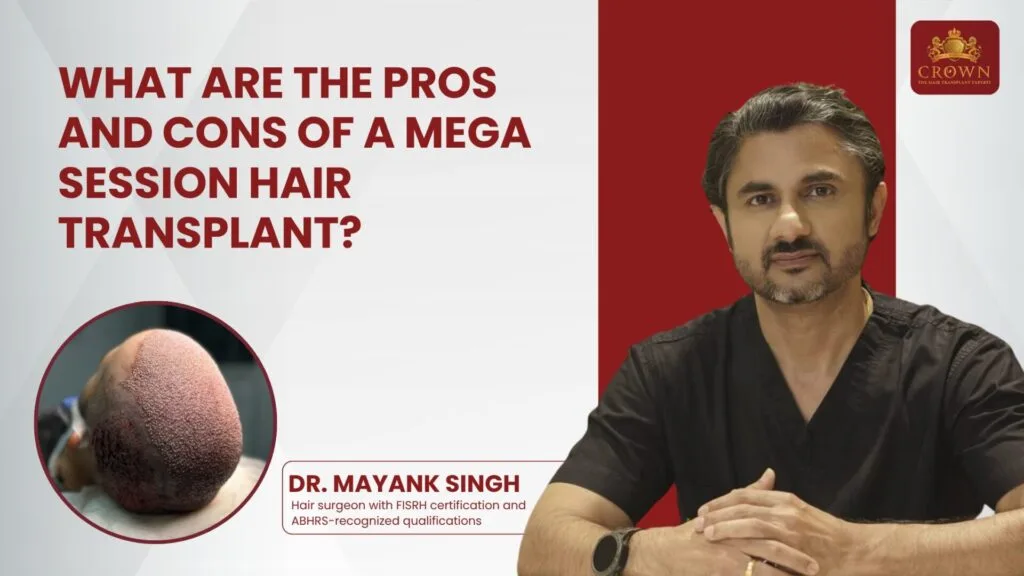
A mega session hair transplant involving 3000 to 5000 or more grafts in a single day provides rapid and dense coverage in fewer sessions, offering cost savings and reduced downtime for patients with severe hair loss. But it carries real risks. Higher donor depletion, compromised graft survival, and unnatural results are all possible when the procedure is not backed by a skilled and adequately staffed surgical team.
According to Dr. Mayank Singh a renowned Hair Transplant Surgeon In Delhi,
“Mega sessions work when planned with precision, but graft viability across an extended session is what ultimately determines whether the outcome justifies the approach.”
What Are the Clinical Advantages of a Mega Session?
For the right patient, a mega session is not just practical. It is often the most efficient clinical path available.
- Maximum Coverage in a Single Sitting: Frontal, mid-scalp, and crown zones can all be addressed in one procedure, and that alone significantly reduces the total number of visits a patient needs to achieve comprehensive restoration.
- Reduced Total Recovery Periods: One session means one recovery. For patients managing professional or personal commitments, avoiding multiple separate downtime periods carries genuine practical value.
- Cost Efficiency for High Graft Requirements: Surgical setup, anaesthesia, and facility costs are consolidated into a single appointment, making a mega session more cost-efficient than two separate procedures delivering the same total graft count.
- Psychological Benefit of Faster Visible Progress: Seeing a comprehensive transformation after a single session rather than waiting through staged procedures over months carries real and meaningful psychological value for many patients.
Patients considering this scale of restoration should confirm their donor density genuinely supports it before committing to hair grafting at this volume.
What Are the Clinical Limitations of a Mega Session?
The limitations of a mega session are real and should not be understated before a patient commits to one.
- Graft Viability Declines During Extended Procedures: Follicles extracted early spend significantly more time outside the scalp than those extracted later, and that differential exposure directly increases survival risk across a proportion of implanted grafts.
- Donor Zone Stress Is Higher in Single Large Sessions: Concentrating high-volume extraction into one sitting stresses the donor zone considerably more than staged sessions do, and this limits what remains available for any future procedures that may be required.
- Surgical Team Fatigue Affects Late-Stage Precision: An eight-hour or longer session is physically demanding for any team, and the risk of inconsistency in angle, depth, and direction during later graft placements is measurably higher than in shorter procedures.
- Not All Patients Are Clinically Suitable Candidates: Limited donor density, reduced scalp laxity, or underlying health conditions can make a mega session inappropriate regardless of how determined a patient is to achieve maximum coverage in one sitting.
Patients assessing their graft requirements can find a detailed breakdown of coverage needs in our blog on full head coverage to better understand what their specific case demands.
Why Choose Dr. Mayank Singh for Hair Transplant in Delhi?
Dr. Mayank Singh is a Diplomate of the American Board of Hair Restoration Surgery, a Fellow of the International Society of Hair Restoration Surgery, and the President of the Association of Hair Restoration Surgeons of India. At Crown Hair Transplant, a trusted centre for hair transplant in Delhi, every mega session assessment begins with a detailed trichoscopic evaluation of the donor area, followed by a clear and honest clinical discussion about whether the patient’s profile truly supports this approach. Recommendations are never based solely on patient preference, but on what the scalp can realistically and safely deliver for optimal long-term results.
Book a consultation with Dr. Mayank Singh at Crown Hair Transplant in Delhi for expert, personalised hair restoration guidance.
FAQs
A session involving 4000 or more grafts is generally classified as a mega session in clinical practice.
Not always, staged sessions often deliver better graft survival and more sustainable donor management in many cases.
Patients with high confirmed donor density, adequate scalp laxity, and good overall health are the most appropriate candidates.
High-volume extraction in one session reduces available donor reserves for future procedures and must be planned conservatively.