
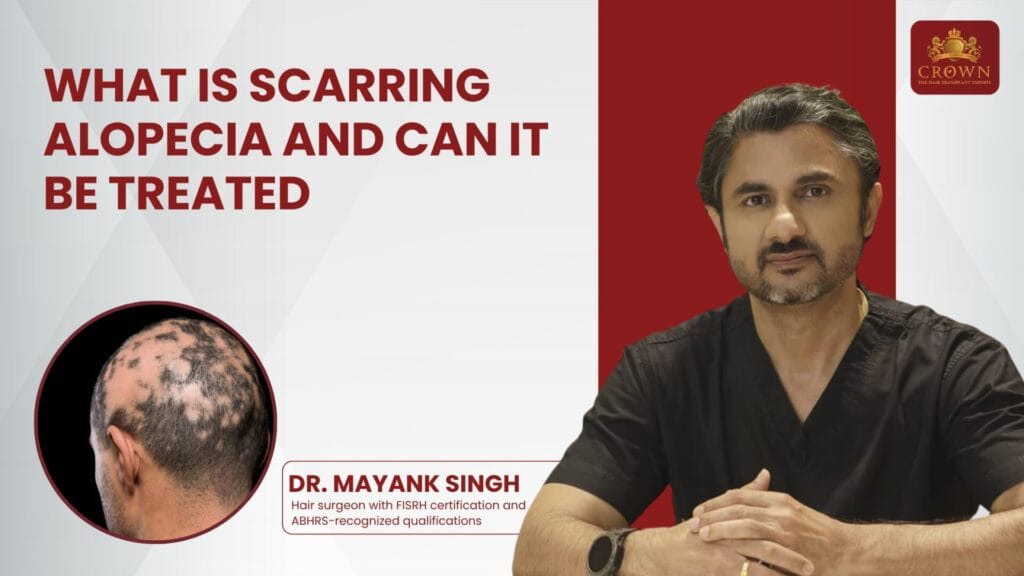
Scarring alopecia is a rare bunch of inflammatory conditions where the follicle itself gets wiped out and scar tissue fills the gap, so regrowth from those roots is off the table. You’ll usually spot it as smooth bald patches with redness, a bit of burning, some itching around the edges, and if nothing’s done the damage keeps creeping outward from there.
According to Dr. Mayank Singh, an experienced hair transplant surgeon in Delhi, “Scarring alopecia isn’t just hair loss, it’s follicle destruction, and by the time someone notices the patch the inflammation has already been working under the surface for months.”
What actually causes scarring alopecia?
Triggers vary by subtype, so a biopsy usually tells you more than a visual exam ever will.
- Autoimmune: Lichen planopilaris and frontal fibrosing alopecia kick off when the immune system misreads follicles as foreign, then goes to work dismantling the exact structures meant to grow hair.
- Infection-driven: Folliculitis decalvans and dissecting cellulitis are the bacterial culprits, deep recurring infections leave scar tissue behind, and hair just doesn’t come back in those patches.
- Mechanical or chemical: Years of tight traction, harsh relaxers, old scalp surgery, any of these can tip into scarring territory if the skin was already prone to inflammation.
- No clear cause: Central centrifugal cicatricial alopecia spreads outward from the crown with no obvious trigger, though genetics and decades of styling seem to nudge it along.
If scarring’s been confirmed and you’re weighing surgery, a hairline restoration consult is your next move, because the plan for scarred scalp looks nothing like a standard pattern baldness case.
Can scarring alopecia actually be treated?
Depends entirely on whether the disease is still active or already burnt out, and those two phases need completely different handling.
- Active phase: Topical and oral anti-inflammatories, think steroids, hydroxychloroquine, doxycycline, are used to shut the fire down, and stopping further follicle loss is the only thing that matters here.
- Stabilisation: Most surgeons want the condition quiet for 12 to 24 months before even discussing surgery, operating on a live scalp usually just means the new grafts get attacked too.
- Surgical restoration: Once stable, FUE into scarred zones can bring coverage back, though graft survival here sits closer to 50 to 70 percent versus the usual 90-plus, and that’s flagged upfront.
- Long-term watch: Even after a clean surgery, trichoscopy checks every 6 to 12 months matter, dormant scarring alopecia has a habit of flaring back years later with no real warning.
For readers with a specific scarring subtype, our blog on hair transplant for frontal fibrosing alopecia walks through how FFA cases get sized up before any surgery gets scheduled.
Why Choose Dr. Mayank Singh for Hair Transplant in Delhi?
Dr. Mayank Singh brings over 15 years in hair restoration with 10,000+ procedures behind him and serves as President of the Association of Hair Restoration Surgeons of India, and that depth shows up in how scarring alopecia cases get staged, where the disease-inactivity window is held to strictly before surgery even gets offered. What patients consistently mention is the honesty around expectations, scar tissue doesn’t behave like healthy scalp, that conversation happens upfront, with realistic graft survival numbers and staged treatment plans instead of one-shot promises.
📞 Call Now: +91-9015112233
Book a consultation with Dr. Mayank Singh at Crown Hair Transplant in Delhi for expert, personalised hair restoration guidance.
FAQs
No, destroyed follicles can’t regrow, but early treatment can save the surrounding unaffected follicles from the same fate.
A scalp biopsy combined with trichoscopy confirms the exact subtype and rules out non-scarring hair loss.
Yes, once the disease has stayed inactive for 12 to 24 months, though graft survival is lower than normal scalp.
Scarring types destroy the follicle for good, non-scarring types like pattern baldness leave follicles intact and still treatable.
Reference link
- Cicatricial Alopecia Clinical Overview — US National Library of Medicine
- Scarring Alopecia Types and Treatment — American Academy of Dermatology