
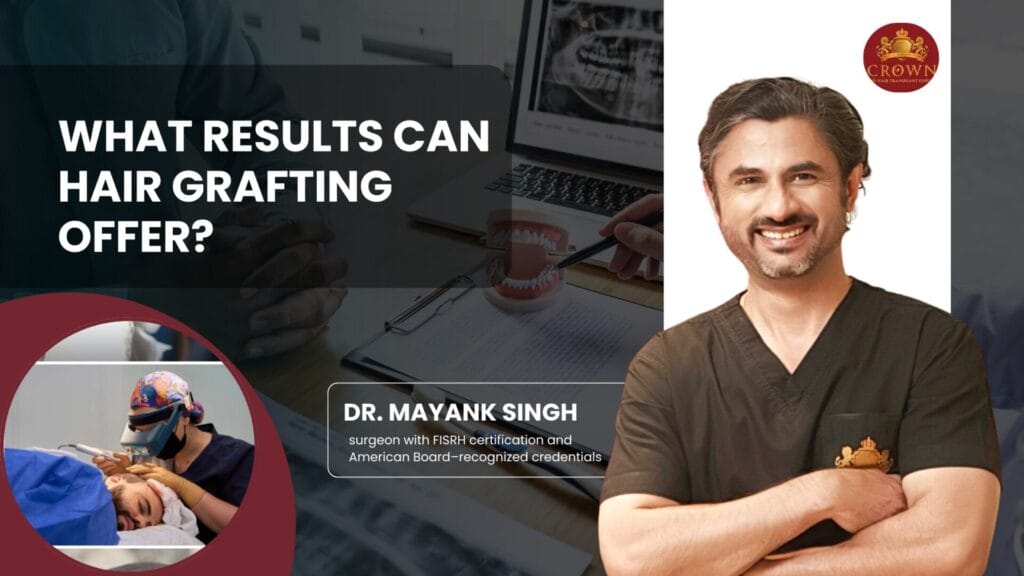
Hair loss often impacts both appearance and self-confidence, especially when thinning becomes noticeable. Hair grafting has emerged as a dependable solution for restoring lost hair by transplanting healthy follicles into areas experiencing reduced density. The procedure focuses on achieving natural growth patterns while improving overall scalp coverage.
According to Dr. Mayank Singh,
Hair grafting delivers the best outcomes when performed on suitable candidates with strong donor hair and stable hair loss patterns. Proper planning ensures that the restored hair blends seamlessly with existing strands for a balanced and long-lasting look.
How Does Hair Grafting Improve Hair Density?
Hair grafting significantly enhances density by redistributing healthy follicles into thinning zones. When performed with precision at Crown Hair Transplant the procedure supports fuller and more uniform hair growth.
- Targeted follicle placement:
Surgeons implant grafts strategically in areas where thinning is most visible. This focused approach maximizes coverage and creates the appearance of thicker hair. - Efficient use of donor hair:
Healthy follicles are carefully selected from the donor region to ensure optimal survival rates. Strong grafts contribute directly to better density outcomes. - Layered density technique:
Gradual implantation helps build volume without overcrowding follicles. This technique allows hair to grow naturally while maintaining scalp health. - Balanced scalp coverage:
Even distribution prevents patchiness and supports a cohesive look across the treated area.
Can Hair Grafting Restore a Natural Hairline?
A natural-looking hairline is one of the most noticeable results patients expect from hair restoration. Modern grafting techniques focus heavily on facial harmony and long-term aesthetics.
- Customized hairline design:
The hairline is planned according to facial structure, age, and future hair loss patterns. This prevents an artificial or overly straight appearance. - Single-hair graft precision:
Finer grafts are placed at the front to create softness and realistic transitions, closely mimicking natural hair growth. - Correct angle and direction:
Each graft is implanted following the natural orientation of existing hair. This ensures seamless blending once growth begins. - Gradual density transition:
Density increases progressively from the hairline toward the mid-scalp, enhancing realism and visual depth.
You may also explore “Can FUE Hair Transplant Bring the Hairline Forward?” for more insight into hairline restoration.
- Customized hairline design:
Why Choose Crown Hair Transplant for Hair Grafting?
Crown Hair Transplant is recognized for combining advanced techniques with personalized treatment strategies. Dr. Mayank Singh, an experienced Hair Transplant Surgeon, evaluates donor strength, scalp health, and long-term hair goals before designing a grafting plan.
Patients should consider visiting the clinic when thinning becomes progressive, hairlines recede noticeably, or non-surgical treatments no longer provide sufficient improvement. With careful execution and aesthetic planning, the clinic focuses on delivering natural density and lasting confidence.
FAQ's
Hair grafting is a core technique within hair transplant procedures involving the transfer of follicular units.
The number varies based on hair loss severity, donor capacity, and desired density.
Yes, when performed by skilled surgeons, results blend seamlessly with existing hair.
Local anesthesia is used, so patients typically experience minimal discomfort.