
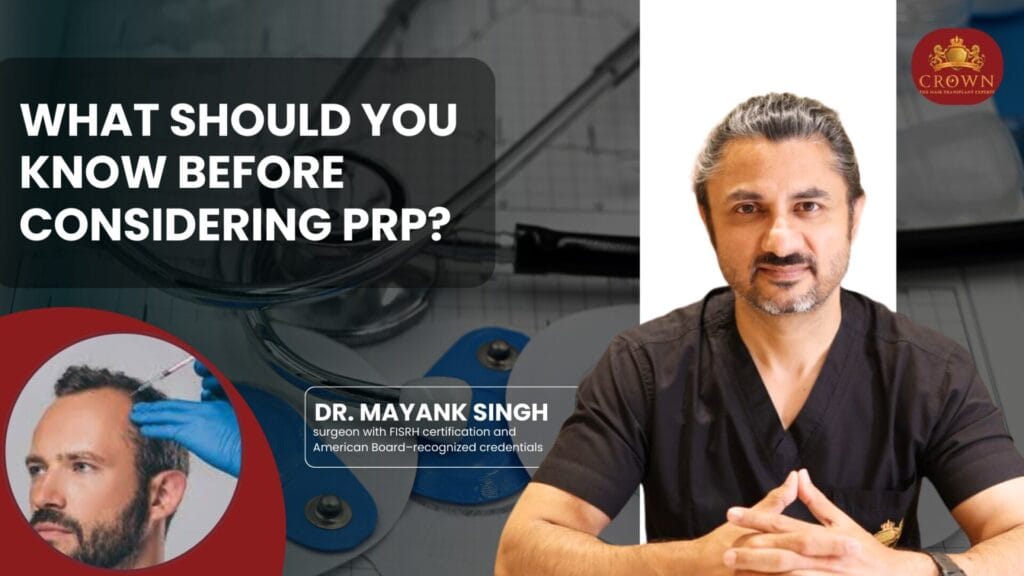
PRP is a non-surgical hair loss treatment that uses the patient’s own platelet-rich plasma, extracted from a blood sample, concentrated through centrifugation, and injected into areas of the scalp where follicles are weakening. It works by delivering growth factors directly to follicle tissue, stimulating activity in follicles that are still present but producing reduced or thinning hair. It does not regenerate follicles that have permanently stopped functioning. Candidacy, timing, and session protocol all determine whether the treatment produces a clinically meaningful outcome.
According to Dr. Mayank Singh,
Hair PRP Treatment works best when follicles are still active and treatment begins before loss becomes too advanced. “PRP supports and strengthens existing follicles. It does not create new ones where none remain.”
What PRP Actually Does and Does Not Do
This is the part most clinics skip over. And honestly it is the most important part to understand before spending a single rupee.
- PRP Uses Your Own Blood: Platelet-rich plasma gets prepared from your own blood sample during the session. It contains growth factors that stimulate follicle activity naturally. There are no foreign substances involved in the process at all.
- It Works on Active Follicles Only: PRP strengthens follicles that are still alive but weakened. If a follicle has already completely shut down and scarred over, PRP cannot wake it back up.
- Multiple Sessions Are Not Optional: One PRP session starts a process. It does not complete one. Most people need at least three to four sessions spaced about a month apart before seeing real visible improvement in hair density and thickness.
- Results Build Slowly Over Months: PRP does not deliver overnight results. Hair growth is a slow biological process. Expecting dramatic change after one session leads to frustration.
- PRP Works Better Alongside Other Treatments: Used alone PRP helps. But paired with microneedling or medical therapy it delivers noticeably stronger outcomes.
To understand how microneedling and PRP work together read our blog “Is Microneedling Beneficial for Uneven Skin?”
Who Is PRP Actually Right For?
Not everyone with hair loss is the right candidate for PRP. Knowing where you fall matters before committing to a full treatment course.
- Early Stage Hair Thinning Responds Best: People who still have a reasonable density of active follicles get the strongest response from Hair PRP treatment. The earlier you start the more follicles are still available to respond to treatment.
- Alopecia Areata Patients Often See Good Results: PRP has shown meaningful improvement in patchy hair loss cases. It reduces inflammation around follicles.
- Advanced Baldness Needs a Different Approach: If large areas of your scalp have been bald for years, PRP alone is unlikely to deliver satisfying results. Surgical options like FUE hair transplant become the more realistic and reliable path forward.
- Overall Health Affects PRP Quality: Platelet quality in your blood directly affects how effective your PRP will be. Nutritional deficiencies, certain medications, and underlying health conditions can reduce platelet concentration and limit how well treatment works.
- Scalp Condition Needs Assessment First: Active scalp infections, severe inflammation, or certain skin conditions need to be addressed before PRP can be safely and effectively administered. A proper scalp check before starting is not a formality. It actually matters.
Why Choose Dr. Mayank Singh for PRP Treatment in Delhi?
Dr. Mayank Singh is the President of the Association of Hair Restoration Surgeons of India, a Diplomate of the American Board of Hair Restoration Surgery, and a Fellow of the International Society of Hair Restoration Surgeons. He is the only surgeon in India to have received the Shelly Friedman Award. For Hair PRP Treatment, preparation concentration, injection depth, session spacing, and follow-up protocol all determine whether the patient sees results or does not. Each case at Crown begins with a full scalp evaluation. Hair loss pattern, follicle health, scalp condition, and platelet quality are all assessed before a single session is recommended. The treatment plan is built around what the individual scalp requires, not a standard course applied uniformly across patients.
📞 Call Now:.+91-9015112233
Book your Treatment consultation at Crown Hair Transplant today. Same-day appointments available for urgent cases.
FAQs
Most people need three to four sessions spaced about a month apart for visible improvement.
Numbing cream is applied beforehand so most people feel only mild pressure during injections.
PRP manages and slows hair loss effectively but works best as part of an ongoing maintenance plan.
No. PRP supports active follicles but cannot restore areas where follicles have already permanently stopped working.