
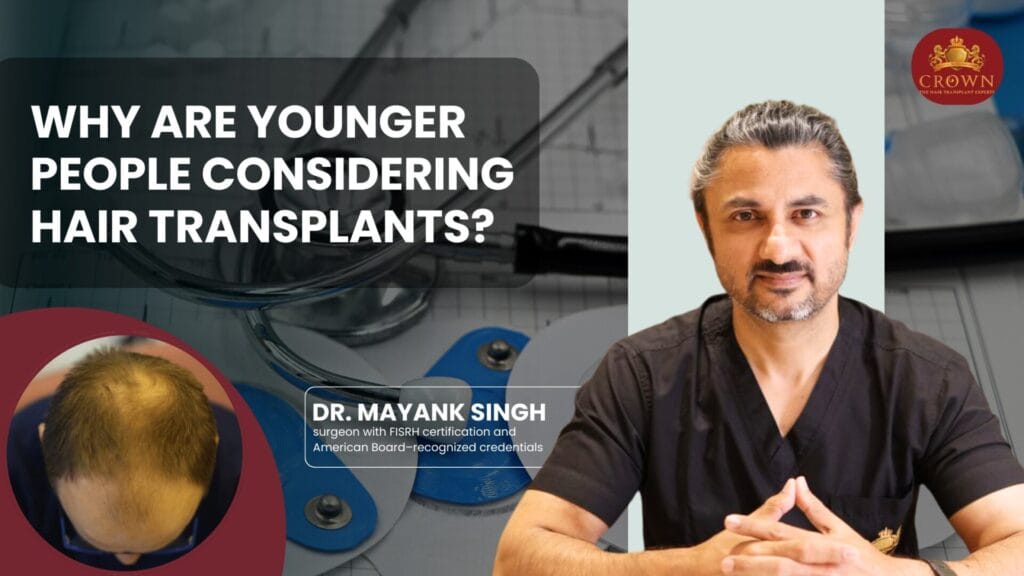
Hair loss is presenting earlier than it historically did, with a growing number of patients in their mid-20s and early 30s seeking surgical consultation for androgenetic alopecia. The combination of earlier onset, greater awareness of available procedures, and faster access to clinical information has moved hair transplant consideration into a younger demographic. Whether surgery is appropriate at that stage is a separate clinical question from why it is being considered.
According to Dr. Mayank Singh,
FUE Hair Transplant consideration among younger patients is increasing, but age alone does not determine suitability. “The critical factors are whether hair loss has stabilised, what the donor density looks like, and how progressive the loss pattern is likely to be.”
Why Are Younger Patients Considering Hair Transplants Earlier?
Several clinical and social factors are driving earlier consultation and treatment consideration among younger hair loss patients.
- Earlier onset of androgenetic alopecia — Genetic hair loss is presenting at a younger age in a measurable proportion of patients. A patient with significant hairline recession at 24 has the same clinical concern as one at 34. The age at which the concern becomes visible, not a fixed demographic threshold, is what drives consultation. At Crown Hair Transplant, onset pattern and progression rate are both assessed before any recommendation is made.
- Greater awareness of minimally invasive options — FUE hair transplant leaves no linear scar, requires no stitches, and allows return to routine within seven to ten days. Younger patients who are aware of these characteristics are less deterred by the surgical nature of the procedure than previous generations were.
- Impact on professional and social confidence — Hair loss at a younger age affects self-perception in professional and social contexts at a stage of life where those interactions carry significant weight. This drives earlier decision-making rather than a “wait and see” approach.
- Non-surgical options have defined limits — Hair PRP Treatment and Microneedling slow progression and support active follicles but do not restore areas where follicles have permanently stopped functioning. Younger patients who reach that threshold earlier are arriving at surgical consultation sooner as a result.
For context on what hair grafting addresses clinically, read our previous blog Is Hair Grafting Right at Any Age?
Should Younger Patients Have a Hair Transplant?
The answer is determined by clinical assessment, not by age. Younger patients face specific considerations that make the surgical decision more complex than it is for older patients with stable, advanced loss.
- Hair loss must be sufficiently stable — Operating on a patient whose hair loss is still progressing rapidly risks producing a result that looks unbalanced within a few years as native hair behind the transplanted zone continues thinning. Medical management to stabilise loss before surgery is frequently the more appropriate first step.
- Donor density determines long-term planning — A younger patient has more years of potential hair loss ahead. Donor follicles used now cannot be used again later. Conservative donor planning at a younger age preserves options for future sessions as loss progresses.
- Hair Grafting planning must account for decades of future change — A hairline designed for a 25-year-old must still look appropriate on that person at 45. Face shape, bone structure, and long-term thinning trajectory all inform where the hairline is placed and how grafts are distributed.
- Non-surgical treatment first where appropriate — Where follicles are still active and loss is early-stage, PRP and medical therapy are recommended before surgery is considered. Surgery is appropriate when non-surgical options have been appropriately exhausted or when loss has advanced past the threshold where they are effective.
Why Choose Dr. Mayank Singh for Hair Transplant Consultation?
Dr. Mayank Singh is the President of the Association of Hair Restoration Surgeons of India, a Diplomate of the American Board of Hair Restoration Surgery, and a Fellow of the International Society of Hair Restoration Surgeons. He is the only surgeon in India to have received the Shelly Friedman Award. For younger patients specifically, the consultation at Crown involves a direct assessment of whether surgery is appropriate now, whether medical management should precede it, and what the long-term plan looks like across the patient’s full hair loss trajectory. A result that looks natural at 25 and still looks natural at 45 requires that level of planning from the outset.
📞 Call Now:.+91-9015112233
Book your Treatment consultation at Crown Hair Transplant today. Same-day appointments available for urgent cases.
FAQs
There is no fixed minimum age. Suitability depends on whether hair loss is sufficiently stable, donor density is adequate, and long-term thinning has been accounted for in the plan.
Genetic androgenetic alopecia can present in the mid-20s. Stress, nutritional factors, and hormonal changes can accelerate the onset in susceptible individuals.
In most cases yes. Operating during active rapid progression risks producing a result that becomes unbalanced as native hair continues thinning behind the transplanted zone.
Yes. PRP therapy and medical management can slow progression and support active follicles, extending the period before surgical intervention becomes necessary.
Long-term thinning projection, conservative donor allocation, and hairline positioning that remains appropriate as the patient ages are all more critical considerations for younger patients than for those with advanced, stable loss.