
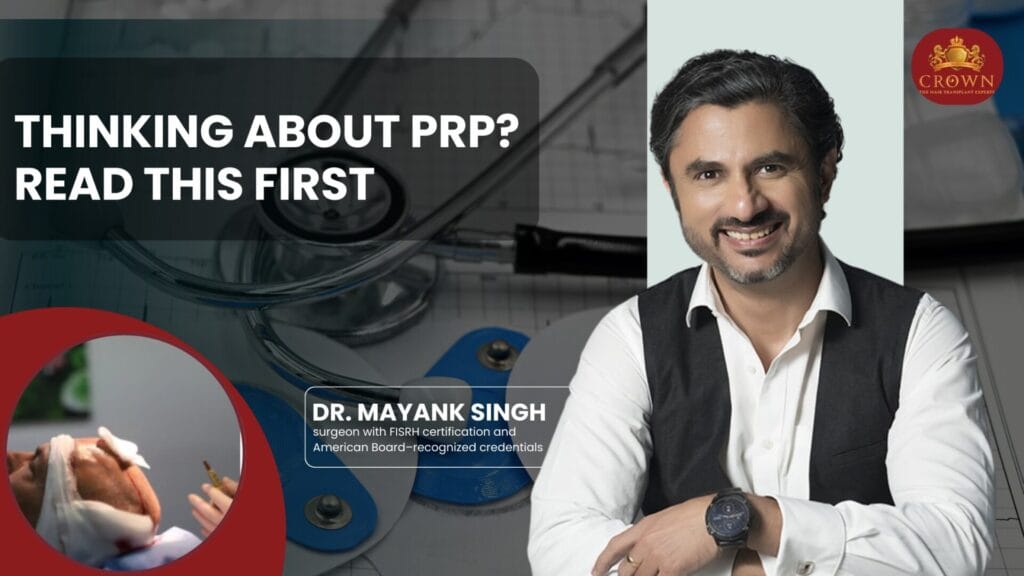
PRP is a non-surgical hair loss treatment that works on specific candidates under specific conditions. It is not a universal solution for all hair loss presentations, and results depend entirely on follicle status, hair loss stage, and adherence to a structured session protocol. Patients who begin PRP without a clinical scalp assessment frequently either start too late for the treatment to be effective or use it as a substitute for an intervention that is more appropriate for their stage of loss.
According to Dr. Mayank Singh,
Hair PRP Treatment is not a shortcut solution. It is a medically guided procedure that requires proper diagnosis and planning. “Understanding hair loss stage and follicle condition is essential before treatment begins.”
What You Need to Understand Before Starting PRP
Each of these points determines whether PRP is the right intervention for a given patient and whether the outcome will be clinically meaningful.
It works best in early hair thinning — PRP produces consistent results when follicles are still active and miniaturising, not when they have already permanently stopped functioning. At Crown Hair Transplant, follicle status is confirmed through scalp assessment before any session is scheduled.
Multiple sessions are required, not optional — A single PRP session initiates a biological process. It does not complete one. Three to four initial sessions spaced four weeks apart are the standard protocol. Incomplete session courses produce incomplete results.
Results are gradual, not immediate — Visible improvement in hair shaft thickness and density appears over months, not weeks. Hair growth is a slow biological cycle. Assessing results at four weeks does not reflect a completed treatment outcome.
PRP is not a replacement for surgical restoration — Where follicles have permanently ceased functioning across significant scalp areas, Hair Grafting is the appropriate intervention. PRP used on permanently inactive follicles produces no result regardless of the number of sessions completed.
For a full breakdown of what PRP does and does not achieve clinically, read our previous blog — Why Is Hair PRP Becoming a Go-To Hair Solution?
Can PRP Be Combined With Hair Transplant?
PRP is used as a supportive therapy alongside surgical hair restoration in selected cases. The combination has specific clinical applications.
- Supports scalp recovery after transplant — Growth factors in PRP improve blood circulation in the treated zone and reduce post-surgical inflammation. This creates a better biological environment for transplanted follicles to establish and survive. FUE Hair Transplant patients who use PRP post-procedure show consistent improvement in graft survival rates.
- Strengthens native hair surrounding the transplant zone — PRP applied to the surrounding scalp area stimulates existing active follicles, improving the overall density of the hair zone beyond just the transplanted grafts.
- Combined with Microneedling for deeper penetration — PRP applied after scalp microneedling reaches deeper into scalp tissue through the micro-channels. The combined effect on follicle activity is measurably stronger than PRP used on an untreated scalp surface.
- Crown area restoration benefits from PRP support — The crown has lower blood supply than the frontal scalp. PRP used post-transplant in the crown zone improves circulation and supports the slower follicle reactivation timeline in that region.
Why Choose Dr. Mayank Singh for PRP Treatment?
Dr. Mayank Singh is the President of the Association of Hair Restoration Surgeons of India, a Diplomate of the American Board of Hair Restoration Surgery, and a Fellow of the International Society of Hair Restoration Surgeons. He is the only surgeon in India to have received the Shelly Friedman Award. For Hair PRP Treatment specifically, every patient undergoes detailed scalp evaluation before any session is recommended. Platelet preparation, injection depth, session spacing, and post-treatment protocol are all structured around the individual patient’s follicle status and hair loss pattern. PRP is recommended based on clinical suitability, not on patient preference or current treatment trends.
FAQs
It is generally considered safe when performed under medical supervision.
Usually 3–4 initial sessions followed by maintenance.
Improvements may start appearing after 2–3 months.
It may reduce thinning in suitable candidates, but results vary.