
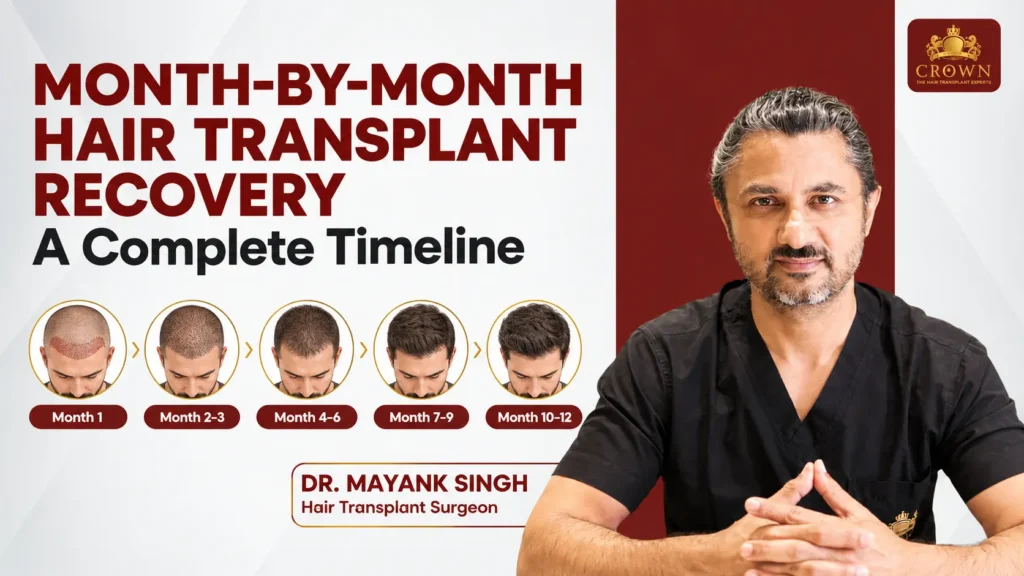
Most patients come into a hair transplant consultation focused on the procedure itself: the technique, the graft count, the hairline design. What they are less prepared for is the recovery. Not because it’s particularly painful or complicated, but because it’s long, and the middle of it looks nothing like the end of it.
“I always tell patients the surgery is one day. The result is permanent. But the year in between asks more of you than the procedure itself ever will. Understanding every stage of that year, before you go through it, is what separates patients who trust the process from those who panic halfway through it.” — Dr. Mayank Singh, Crown Hair Transplant, New Delhi
The honest version of this conversation is one I have with every patient at Crown before we schedule anything: a hair transplant result takes a full year to develop. There are weeks in that year when the result looks worse than it did before surgery. There are months when nothing visible seems to be happening at all. And then, gradually, it does, and by month nine or ten, most patients can’t quite remember what the anxiety was about.
This guide walks through each stage in the order you’ll actually live through it, so there are no surprises along the way.
Before the Clock Starts: What Happens on Surgery Day
Recovery begins the moment the last graft is placed. The recipient zone will look busier and denser than the final result; newly implanted grafts sit slightly proud of the skin surface, the scalp is pink, and there will be small crusts forming at each implantation site by the end of the day.
Patients leave Crown on the same day with a bandage on scalp and visit again after 48 hours for the bandage to be removed and first shampoo given. Patients depart with written aftercare instructions, prescribed medication, and their next follow-up already scheduled. The aim is that nobody goes home uncertain about what to expect next.
Week 1: Handle With Care
The first week is the most physically delicate phase of the whole process. The newly placed grafts are mechanically held in position by the surrounding tissue, but they haven’t established a blood supply yet, which means they can still be dislodged by direct physical pressure or friction.
What patients typically notice:
- Mild forehead swelling, rarely tracking down toward the eyes by day two or three as fluid migrates downward with gravity. It looks alarming, passes within a few days, and is entirely normal.
- Pinkness and small crusts forming around each graft site
- Tightness or mild soreness in the donor zone, more pronounced with FUT than FUE
- Needing to sleep propped up at a roughly 15 to 25° angle, which most patients find more uncomfortable than anything surgical
The only real rule this week is restraint. No touching the recipient zone, no strenuous activity, and careful, gentle washing with the prescribed solution from around day three. The grafts need to be left completely alone.
Week 2: Things Start to Settle
The swelling has gone, the donor zone is healing, and the crusts around the graft sites begin to loosen and fall naturally during washing. FUT sutures used are dissolvable and around 3 to 4 weeks they dissapear, which most patients find considerably less dramatic than anticipated.
Some transplanted hairs may still be attached to scabs as they shed; this is normal, and it is not the same as losing the graft. The follicle remains anchored beneath the surface.
By the end of week 2, the scalp starts to look and feel more like itself, and most patients are back to work and functioning normally. The temptation to pick at remaining scabs is real and worth resisting; they will go on their own.
Weeks 3–6: The Part Nobody Warns You About Enough
This is the shedding phase, and it deserves its own honest conversation.
Somewhere between weeks 2 and 6, the transplanted hair shafts begin to fall out. For most patients, this happens in noticeable quantities. The recipient zone, which looked reasonably dense in the first week, starts to look sparse. Sometimes sparser than it did before surgery.
The biological explanation is straightforward: the implanted follicles, in response to the stress of transplantation, enter a resting phase called effluvium . The hair shaft is shed. The follicle itself remains intact beneath the scalp and will re-enter the growth phase in due course. This is a normal part of how every hair transplant result develops.
Knowing this intellectually and experiencing it are two different things. Almost every patient finds this period difficult, even when they’ve been told what to expect. Some existing native hair in the treated zone may also thin temporarily, called shock loss, which adds to the impression of regression.
The only thing to do during this phase is continue the aftercare protocol, stay consistent with any prescribed medical therapy, and wait. There is no intervention that meaningfully accelerates follicular recovery at this stage.
Months 2–3: The Quiet Phase
If the shedding phase is the most distressing part of recovery, months 2 and 3 are the most boring, and for some patients, that’s almost worse.
The shedding has stopped. The scalp is healed. And nothing visible seems to be changing. The recipient zone looks sparse, and the transplanted area can feel like it’s sitting in a kind of suspended animation.
What’s actually happening beneath the surface is significant: the implanted follicles are re-establishing their vascular connections and preparing to re-enter the active growth phase. It just doesn’t look like anything from the outside.
At Crown, we typically recommend PRP (Platelet-Rich Plasma) sessions during this window at around months 2 and 3 to support follicular recovery and encourage an earlier, stronger transition into the growth phase. It’s also the time when continuing prescribed medical therapy without interruption matters most, since the follicles are preparing to grow and the conditions around them should be as supportive as possible.
Month 4: Something Is Finally Happening
This is the month most patients have been waiting for, and it does not disappoint.
Fine new hair begins to emerge in parts of the recipient zone. It’s often thinner and sometimes slightly lighter in colour than the patient’s natural hair. This is the first growth phase, and the calibre increases considerably as it matures. Growth is rarely uniform at this stage; some areas lead, others follow.
A word of caution worth offering here: month 4 growth can look underwhelming relative to the final result, and it’s easy to set a premature narrative about how the transplant has performed. The hairs visible now will thicken significantly over the next few months. The density at month 4 represents, very roughly, 50–70% of what the final result will be. Patience still applies.
Month 6: The Point Where It Starts to Make Sense
By month six, the majority of implanted follicles have re-entered the active growth phase, and the difference from month 4 is usually striking. Density has improved meaningfully, shaft calibre has increased, and the hairline begins to take shape in a way that sometimes matches for the first time what was sketched out in the planning conversation months earlier.
Most patients begin to feel genuinely positive about the direction of their result around this point. There is still growth to come; month 6 typically represents around 70–80% of the outcome, but the trajectory is clear enough to be encouraging.
This is also a good point for a mid-recovery review, which is built into Crown’s follow-up schedule. It allows an honest assessment of density, growth distribution, and whether any adjustments to medical therapy are warranted.
Month 9: Close to the Finish Line
At nine months, the result has matured substantially. The transplanted hair can be styled normally. The hairline is clearly defined. The density across the treated zone has improved to the point where most patients are comfortable with how it looks day to day, in most lighting conditions.
Areas that appeared uneven or slow at month four or five have, in most cases, resolved. The occasional patient who had been quietly anxious about progress through months five and six is typically more settled and satisfied at this point.
There is still some refinement to come; calibre continues to mature, and density can still improve between months 9 and 12, but the overwhelming direction of the result is visible.
Month 12: The Actual Result
Twelve months is the standard benchmark for assessing a hair transplant outcome. By this point, the implanted follicles have completed their first full growth cycle, hair calibre has reached its maximum, and density is stable.
The result can be fairly evaluated against the goals discussed in the pre-operative consultation. The hairline should look natural and behave normally. The transplanted hair should be indistinguishable from surrounding native hair in texture and growth pattern. The donor zone should show no visible depletion at normal hair lengths.
For patients with very coarse or slow-cycling hair, or those who had particularly high graft counts, there may be continued incremental improvement up to 18 months. The 12-month point is the minimum threshold for assessment, not a hard ceiling.
After Month 12: The Longer Picture
Transplanted follicles are permanent; they carry the DHT-resistant genetics of the donor zone and will not follow the same loss pattern as the hair that was originally lost. But the native hair surrounding the transplanted zone continues to be susceptible to androgenic alopecia, and it continues to behave accordingly unless it’s being managed medically.
The most common thing I see in long-term follow-up patients is the gradual thinning of native hair in areas adjacent to an otherwise excellent transplant result. The transplanted zone holds. The native hair around it thins. The contrast becomes visible. This is why continuing finasteride and minoxidil where appropriate beyond the transplant itself isn’t optional maintenance; it’s the second half of a complete treatment plan.
Conclusion
Hair transplant recovery is a year-long process with a learning curve most patients didn’t expect. The shedding phase is hard. The quiet months are harder, in a different way. And then, gradually and then all at once, the result arrives.
At Crown, every patient is supported through each stage of this timeline with pre-operative counselling, structured follow-up appointments, and a direct line for questions at any point during recovery. The procedure is one day. The result is permanent. The year in between deserves the same level of care as the surgery itself.
If you’re considering a hair transplant and want to understand exactly what the recovery would involve for your specific case, book a consultation with Dr. Mayank Singh at Crown Hair Transplant, New Delhi. You can read the reviews posted by our patients on different different healthcare reviews websites to have a better idea of what our patients have to say about us.
Book a consultation with Dr. Mayank Singh at Crown Hair Transplant in Delhi for expert, personalised hair restoration guidance.
FAQs
The full result is typically visible and assessable at 9 to 12 months. Some patients, particularly those with coarser hair or higher graft counts, may see continued improvement up to 18 months. No meaningful judgement about density or coverage should be made before the twelve-month mark; what you see at month 4 or 5 is not the finished picture.
Yes, and this catches almost every patient off guard even when they have been told to expect it. The shedding phase between weeks 2 and 6, combined with possible shock loss in the surrounding native hair, means the recipient zone often looks thinner at months two and three than it did immediately post-surgery. It is temporary, it is normal, and it resolves.
The biological timeline is largely fixed, but several things support a stronger recovery: following the post-operative care protocol exactly as given, continuing prescribed medical therapy without interruption, attending PRP sessions if recommended, protecting the scalp from sun exposure in the first three months, and maintaining adequate protein and iron intake. These don’t accelerate the calendar, but they create the best possible conditions for the follicles doing the work.
Light walking is fine from day three or four. Strenuous exercise anything that significantly raises heart rate, blood pressure, or produces heavy sweating should be avoided for at least 2 full weeks. Normal gym activity can typically resume from weeks 3 to 4. Contact sports and high-impact activities are best avoided until at least month three.
In most cases, yes, transplanted follicles retain the characteristics of the donor zone, so scalp hair taken from the back and sides grows with the same texture, wave, and cycle as the hair it came from. Some patients notice a slightly different texture during the early growth phase at months 4 to 6, which normalises as the hair matures through its first full cycle.
No. Growth timelines vary considerably between individuals based on hair cycle length, donor characteristics, scalp vascularity, and general health. A patient who sees growth at month three is not having a better outcome than one whose growth begins at month five. The quality and density of the final result at twelve months is what matters, not how early the first hairs appeared.
Transplanted follicles are genetically resistant to DHT and will not be lost to androgenic alopecia. The result at 12 months is permanent in that sense ,though these follicles may thin out with senile degeneration or thinning with age .What continues to change is the native hair surrounding the transplant, which remains susceptible to ongoing androgenic loss unless managed medically. This is why long-term use of finasteride and minoxidil, where clinically appropriate, remains relevant well beyond the transplant itself.